When a new product hits the market, you’d expect it to be expensive. Premium features, cutting-edge tech, brand reputation - all that should justify a high price, right? But here’s what actually happens: the moment a first generic entry appears, prices collapse. Not slowly. Not over years. Sometimes within weeks.
This isn’t just about tech or drugs. It’s about power shifting from sellers to buyers. And if you’ve ever wondered why your favorite software suddenly got 60% cheaper, or why that TV you wanted last year is half-price now, this is why.
What Exactly Is a First Generic Entry?
A first generic entry is the very first alternative version of a product that’s been locked down by patents, proprietary tech, or market dominance. It doesn’t copy everything perfectly - but it copies enough to work. And it’s always cheaper.
In pharma, it’s when a drug’s patent expires and another company makes the same medicine for 80% less. In software, it’s when a startup builds a database that works like Oracle but runs on Linux and costs $500 a year instead of $50,000.
The key? They don’t need to be better. They just need to be good enough. And they’re priced to win.
Why Do Prices Plummet So Fast?
It’s not about cost. It’s about perception.
When a company owns a market with no real competition - say, a proprietary database or a branded medical device - they can charge what they want. Customers have no choice. But the second someone else shows up with a working alternative, everything changes.
Customers suddenly realize: “Wait, I was paying three times more for the same thing?”
That’s when the incumbent panics. They can’t just say, “We’re better.” They have to prove it. And the easiest way to prove it? Lower the price.
Here’s what the data shows:
- In pharmaceuticals, the first generic drug cuts prices by an average of 76% within six months (Congressional Budget Office).
- In enterprise software, first-time competitors launch at 40-60% below the incumbent (PwC).
- When Apple’s iPod faced competitors, prices dropped from $399 to under $50 within five years.
The drop isn’t random. It’s calculated. The new player knows they can’t out-innovate the big brand. So they undercut. And they win.
How Do Generic Alternatives Afford to Be So Cheap?
They don’t build from scratch. They build on top of what already exists.
Take PostgreSQL - an open-source database. It’s not made by a giant corporation. It’s built by thousands of developers, many volunteering their time. The code is free. The infrastructure runs on cheap Linux servers. No need to pay for fancy offices or global sales teams.
Compare that to Oracle, which spent decades building proprietary systems, hiring expensive engineers, and selling through enterprise contracts. Their costs are baked into every license.
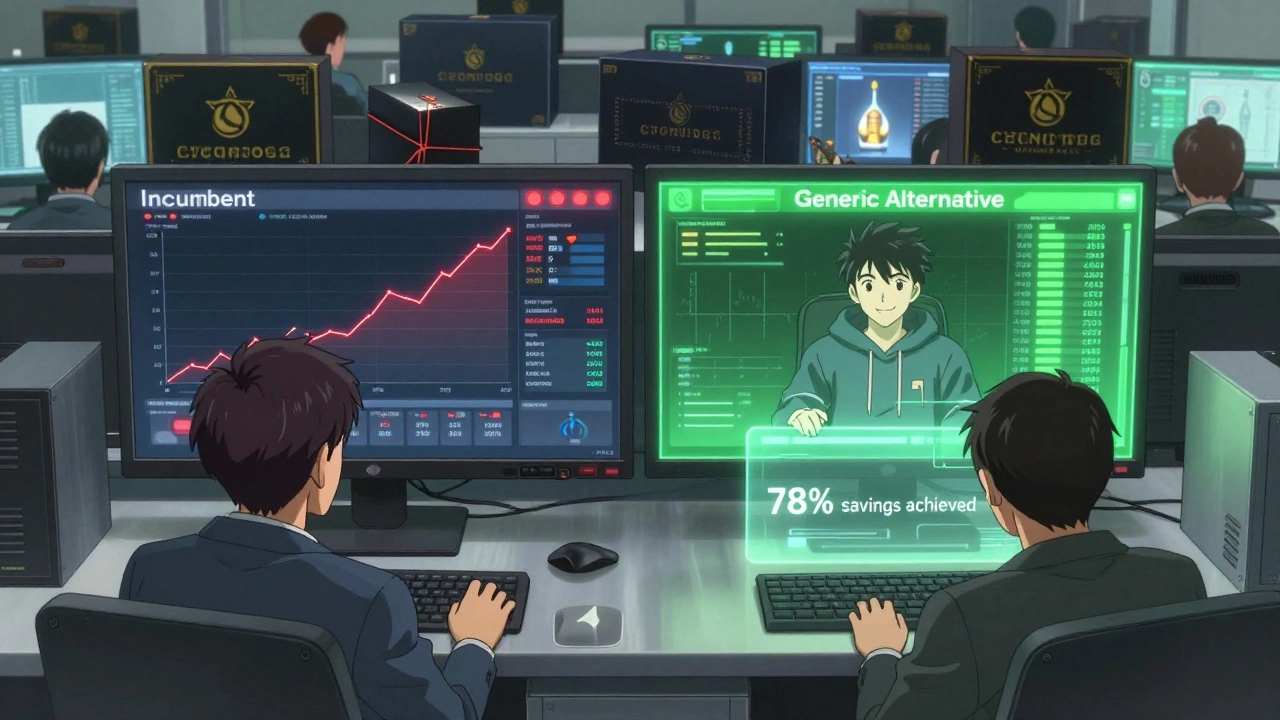
Generic entrants also skip the marketing fluff. No billboards. No fancy conferences. Just word-of-mouth, Reddit threads, and GitHub stars. One Reddit user wrote: “Switched from Oracle to PostgreSQL. Saved 78% on licensing. Same performance.” That’s worth more than any ad campaign.
And they use modern tools. Cloud-native architectures. Containerized deployments. Automated testing. These cut development time and overhead by 60-70% compared to old-school on-premise software.
What Happens to the Original Company?
They either adapt or get left behind.
Microsoft saw the writing on the wall with SQL Server. When PostgreSQL and open-source alternatives started eating their lunch, they didn’t fight it. They changed. In 2022, they launched Azure SQL Database with pay-as-you-go pricing. Prices dropped 35% for mid-sized businesses overnight.
Oracle tried to hold the line. But now, 67% of Fortune 500 companies have formal processes to evaluate generic alternatives within three months of launch (Gartner, 2023). That’s not a trend. That’s a new rule.
Even big brands now offer free tiers. MongoDB, once a premium database, now gives away its core product for free and makes money on support and cloud tools. That’s the new model: give away the base, charge for the extras.
Is There a Catch?
Yes. But it’s not what you think.
Generic alternatives don’t magically fix everything. Early adopters often report:
- 20-30% more setup time
- Less polished documentation
- Slower vendor response times
But here’s the twist: most companies don’t care. Why? Because the savings are so huge that the trade-offs are worth it.
TrustRadius found that 81% of enterprises stick with generic software after the first year. Why? ROI kicks in within 6-9 months. That’s faster than most corporate budget cycles.
And support? It’s improving fast. Spiceworks’ 2023 study showed generic vendors now match incumbents on response time within 15%. Community forums and Stack Overflow have replaced expensive help desks.
The real risk isn’t quality. It’s inertia. Companies that wait too long to switch end up paying more for outdated tech while competitors move ahead.

What’s Next? The Future Is Even Cheaper
The pace is accelerating.
In 2010, it took an average of 18 months after a patent expired for the first generic to appear. In 2023? Just six months. That’s three times faster.
Why? Because building software is easier now. Open-source tools. Cloud infrastructure. AI-assisted coding. You don’t need a billion-dollar team to build a competitor anymore.
ARK Invest predicts open-source alternatives will capture 35% of enterprise software revenue by 2027. That’s not a guess. It’s a trajectory.
And regulators are helping. The EU’s Digital Markets Act now forces big tech to make their products interoperable. That means switching costs are dropping by 40-50%. More choice. Lower prices.
By 2025, you won’t just see generic entries in software and pharma. You’ll see them in CRM tools, HR platforms, cybersecurity suites - even accounting software.
What Should You Do?
If you’re buying:
- Wait 3-6 months after a new product launches. Prices always drop.
- Look for open-source or commercial open-source alternatives. They’re often 50-80% cheaper.
- Check reviews on G2 or Capterra. Look for “cost savings without functionality loss.” That’s the golden phrase.
If you’re selling:
- Don’t wait for a competitor to force your hand. Start experimenting with usage-based pricing now.
- Offer a free tier. Let people try before they buy.
- Focus on support, training, and integration - not license fees.
The game has changed. You can’t win by charging more. You win by being the best value.
Real-World Examples You Can Use Today
- Database: Instead of Oracle, try PostgreSQL. Savings: 70-85%.
- CRM: Instead of Salesforce, try HubSpot Free or Odoo. Savings: 60-90%.
- Analytics: Instead of Tableau, try Metabase or Apache Superset. Savings: 80%+.
- Video Conferencing: Instead of Zoom Pro, try Jitsi Meet. Free. Open-source. No limits.
These aren’t niche tools. They’re used by banks, hospitals, and universities. They’re stable. They’re secure. And they’re dirt cheap.
Why pay more when you don’t have to?





Kshitij Shah
December 3, 2025 AT 00:25And don't even get me started on Salesforce vs HubSpot Free. I've seen startups run entire sales ops on free tools while Fortune 500s are still paying $20k/month for features they never use.
Sean McCarthy
December 4, 2025 AT 08:27Jaswinder Singh
December 6, 2025 AT 01:58They don't get it. They think we're dumb for switching. We're not dumb. We're just not stupid.
Bee Floyd
December 8, 2025 AT 01:37And then one day, a small company in Bangalore uses it to replace a $50k/year license. A university in Iowa follows. Then a hospital in Ohio. No fanfare. Just steady, unstoppable adoption.
It's not about being 'anti-corporate'. It's about being pro-efficiency. And honestly? It's kind of poetic.
Jeremy Butler
December 9, 2025 AT 20:29Courtney Co
December 10, 2025 AT 11:57Shashank Vira
December 12, 2025 AT 06:52Let us not forget that Oracle's RAC, with its decades of tuning, redundancy, and failover protocols, is not merely a database-it is an institution. PostgreSQL? A well-meaning hobby project with 17,000 GitHub stars and zero SLAs.
Yes, it's cheaper. But is it wise? Are you prepared to be the one explaining to the CIO why your 'free' database crashed during Q4 reporting?
Some of us value reliability over radical cost-cutting. The market may shift, but wisdom endures.
Eric Vlach
December 14, 2025 AT 03:49And yeah sure setup takes longer but once it's running? It's yours. Not theirs. That matters more than people admit.
Souvik Datta
December 14, 2025 AT 19:42What we're witnessing is the quiet revolution of competence over branding. A developer in Kerala can build something better than a team in Silicon Valley-not because they're smarter, but because they're free to innovate without corporate baggage.
So if you're still paying for bloated licenses? You're not being prudent. You're being loyal to a myth.
Priyam Tomar
December 15, 2025 AT 14:26And let's be real-most of the 'generic' tools you're praising? They're still using the same architecture from 2010. The real innovation is happening in AI-native tools nobody's talking about because they're not open source yet.
Wait until the next wave hits. You'll be begging for the old expensive stuff again.