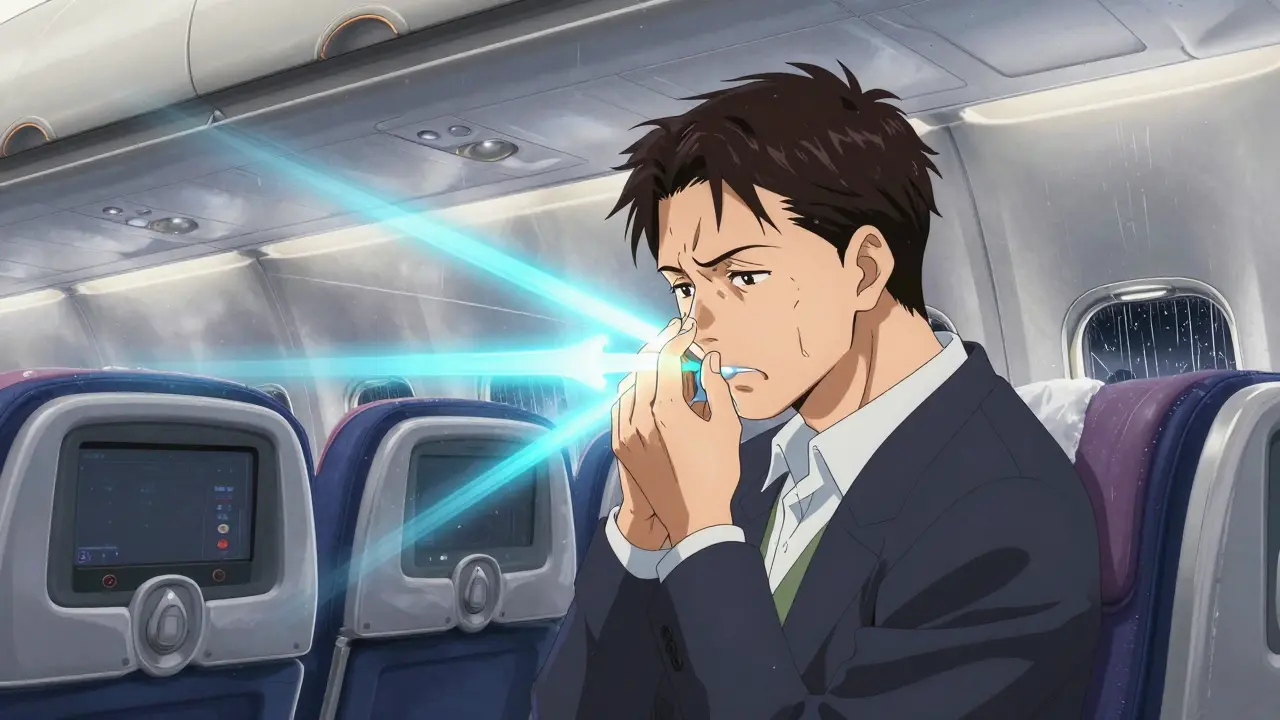
Ever landed with your ears ringing, muffled, or painfully blocked? You’re not alone. Around 10% of adults and over 22% of kids experience airplane ear on every flight - and that number jumps to 34% if you’ve got a cold, allergies, or sinus issues. It’s not just annoying. Left unchecked, it can cause temporary hearing loss, dizziness, or even a ruptured eardrum. The good news? You can prevent it. Most people wait until it hurts to do something - but by then, it’s too late. The key is to start equalizing pressure before pain hits.
Why Your Ears Hurt During Flights
Your middle ear is an air pocket sealed behind your eardrum. It’s connected to the back of your throat by a tiny tube called the Eustachian tube - about 35mm long in adults, and even shorter in kids. This tube opens when you swallow, yawn, or chew, letting air flow in or out to balance pressure between your ear and the cabin. As the plane climbs, cabin pressure drops. Your middle ear pressure stays higher, so your eardrum bulges outward. That’s usually not painful. But when the plane descends, cabin pressure rises faster than your ear can adjust. The higher outside pressure pushes your eardrum inward. If the Eustachian tube won’t open, you feel pressure, fullness, and eventually pain. This is called barotrauma. The pressure difference can hit 40 mmHg during rapid descents - enough to pull your eardrum tight enough to distort hearing. Kids are more vulnerable because their Eustachian tubes are smaller, more horizontal, and less likely to open on their own. That’s why babies and toddlers cry during landing - they’re in pain.How to Equalize Pressure Safely
You don’t need fancy gear. Just know which techniques work, when to use them, and how to avoid mistakes.- Swallow or yawn - This is the easiest, safest method. Do it every few minutes during descent. Even chewing gum helps. It works for 65% of people, and carries zero risk.
- Toynbee maneuver - Pinch your nose shut and swallow. This pulls air into the middle ear. It’s safer than blowing, and works for 68% of users. Great for kids who can’t blow properly.
- Lowry technique - Combine swallowing and gentle blowing. Pinch your nose, swallow, and blow softly at the same time. This hits 89% effectiveness in experienced users, but takes practice. Most people get it right after 2-3 flights.
- Jaw wiggle - Move your jaw side to side while swallowing. A simple trick, but it improves success by 22% in children, according to ENT specialists. Try it with toddlers - it’s easier than making them swallow on command.
- Valsalva maneuver - Pinch your nose and blow gently. This forces air into the middle ear. It works for 82% of adults - but only if you do it right. Blow like you’re trying to fog up a mirror, not like you’re blowing up a balloon. Force it too hard, and you risk inner ear damage. That’s why doctors call it a last resort.
Never blow hard. Never do it while you’re in pain. Never force it. If you feel a pop, stop. If you feel more pressure, stop. Pushing through pain is how ruptured eardrums happen.
Earplugs That Actually Work
Not all earplugs are created equal. Regular foam plugs just block sound - they don’t help with pressure. But filtered earplugs like EarPlanes are designed to slow down pressure changes. They use a ceramic filter that reduces the rate of pressure shift by 37%, giving your Eustachian tube an extra 13 seconds to catch up. In clinical trials, EarPlanes helped 76% of users avoid discomfort. But they’re not magic. If your tubes are chronically blocked by allergies or infection, their effectiveness drops to 42%. Still, they’re worth trying - especially if you fly often. They cost about $5 a pair and are reusable for up to 10 flights.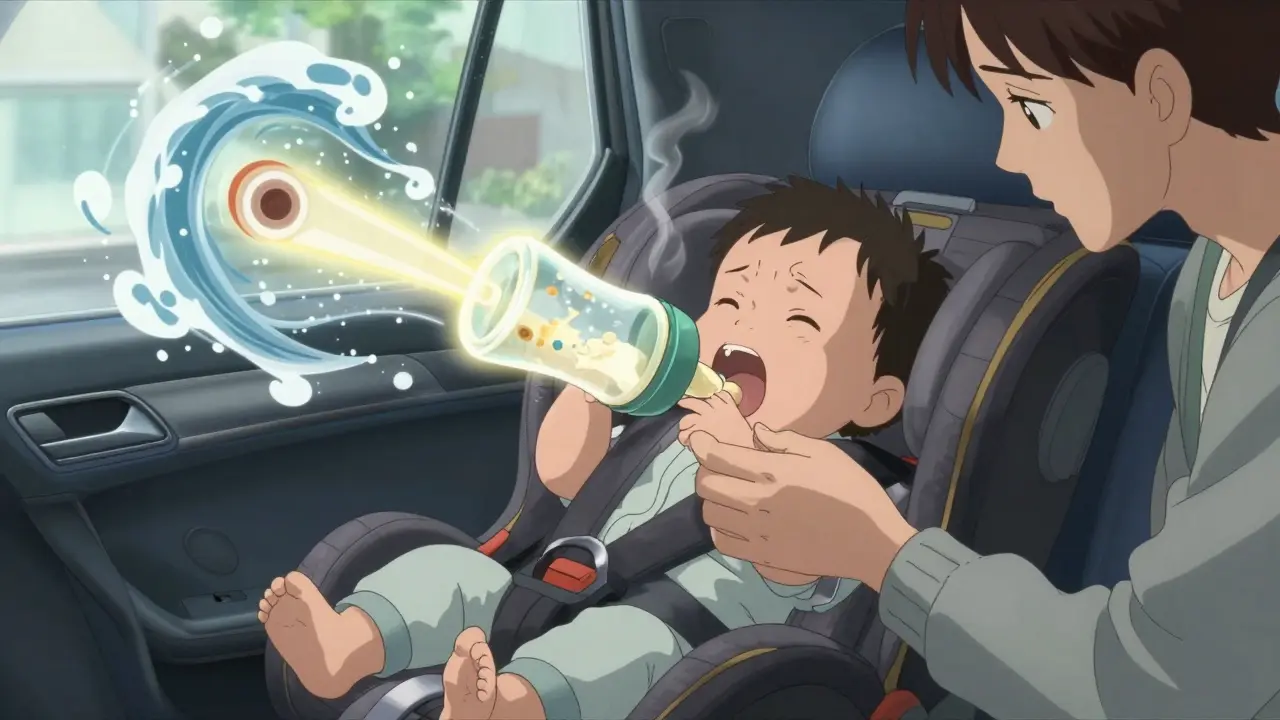
Decongestants: Use With Caution
If you’re congested, your Eustachian tube is swollen shut. Decongestants can help - but only if used correctly.- Nasal sprays like oxymetazoline (Afrin) shrink swollen tissue in 10 minutes. Use them 30-60 minutes before descent. Don’t use them for more than 3 days - they cause rebound congestion.
- Oral decongestants like pseudoephedrine (Sudafed) last longer - 8-12 hours. But they raise blood pressure and heart rate. Avoid them if you’re over 40, have heart issues, or take blood pressure meds. The FDA warns that 12% of adults over 40 experience side effects.
- For kids under 6: Never use oral or nasal decongestants. The risk of rapid heartbeat (tachycardia) is real, even if rare (0.07% in FDA reports). Instead, use bottle-feeding during descent. Babies who suck on a bottle equalize pressure 43% better than those who sip from a cup.
There’s a newer option: Otovent, a nasal balloon device approved by the FDA in 2022. You inflate it through one nostril - the pressure opens the Eustachian tube. Clinical trials show 88% effectiveness. It’s safe for kids and adults. You can buy it online or at some pharmacies.
Timing Is Everything
Waiting until your ears hurt is the #1 mistake. By then, the pressure difference is too big, and your tubes are already locked shut. Start equalizing at 8,000 feet - that’s when the cabin pressure begins to rise rapidly on descent. Don’t wait for the seatbelt sign to turn off. Begin swallowing, yawning, or doing the Toynbee maneuver as soon as the plane starts down. Do it every 300-500 feet of descent. That’s about every 2-3 minutes. For kids, keep them awake during descent. Sleeping is the #1 reason kids get ear pain. If they’re asleep, gently wake them up to feed or give them a pacifier. Even a few swallows can make the difference.What Airlines Are Doing to Help
Newer planes like the Boeing 787 keep cabin pressure at 6,000 feet instead of the old standard of 8,000 feet. That’s a 25% reduction in pressure change. Delta Airlines now uses a 3-degree descent angle instead of 3.5 degrees - slowing the pressure rise by 14%. All major U.S. airlines now train flight crews to recognize ear pain and offer advice. Some even hand out gum or earplugs on long flights.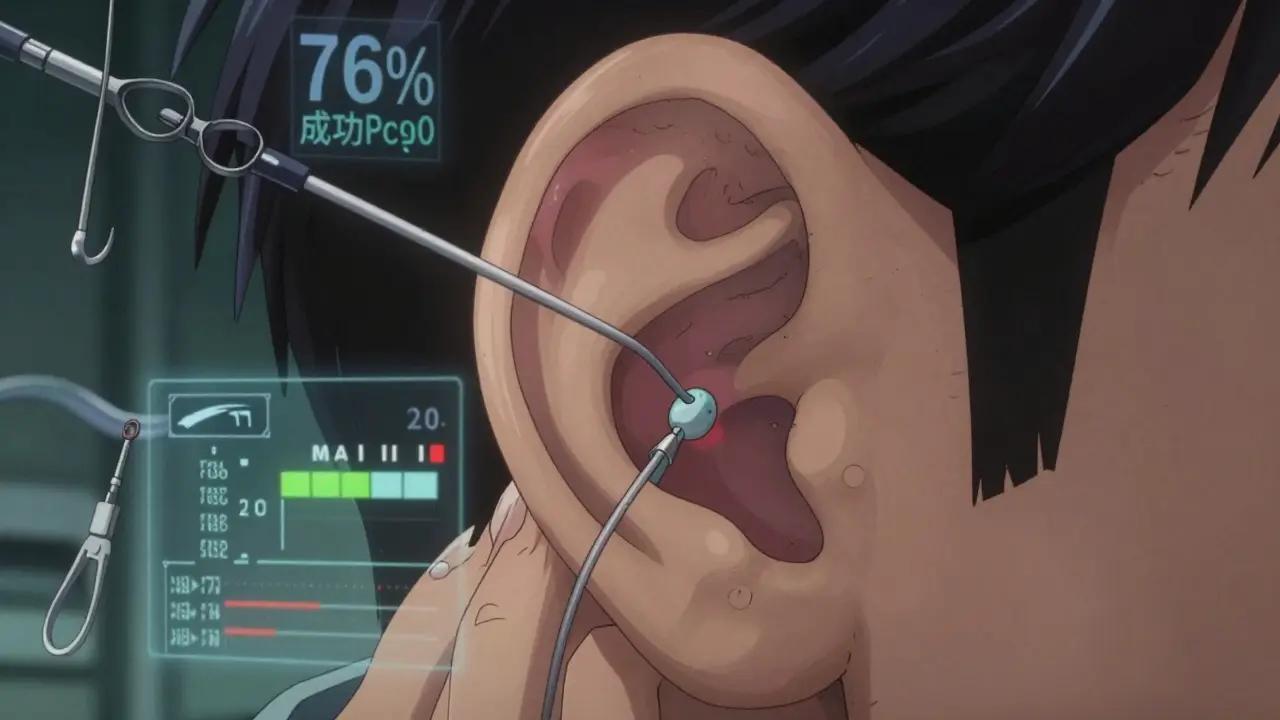
What Not to Do
- Don’t sleep during descent - Especially with kids. 73% of pediatric ear pain cases happen because the child was asleep.
- Don’t blow too hard - 41% of inner ear injuries from barotrauma come from forceful Valsalva.
- Don’t use decongestants if you’re pregnant, have high blood pressure, or are under 6.
- Don’t rely on one trick - Combine methods. Use EarPlanes + jaw wiggles + swallowing. One Reddit user reported 91% success after combining three techniques.
Long-Term Solutions for Chronic Problems
If you get airplane ear every single flight - even when you’re healthy - you might have chronic Eustachian tube dysfunction. It’s not rare. About 1 in 50 adults have it. New treatments are emerging:- Balloon dilation - A tiny balloon is inserted into the Eustachian tube and inflated to widen it. Success rate: 76% long-term. Cost: $3,800-$5,200 out-of-pocket in the U.S.
- Eustachian tube stents - Tiny implants that keep the tube open. Phase 2 trials at Mayo Clinic show 92% success. Still experimental, but coming soon.
- Nasal steroid sprays - Fluticasone (Flonase) used daily for a week before flying reduces inflammation in the tube by 61%, improving equalization by 33% according to University of Pennsylvania research.
If you’re constantly struggling, see an ENT specialist. There’s help - and it’s getting better.
Pre-Flight Checklist
- Start swallowing or chewing gum 30 minutes before descent.
- Use filtered earplugs (like EarPlanes) if you fly often.
- If congested, use nasal spray 1 hour before flight - but not if you’re pregnant or under 6.
- For kids: Feed or give a pacifier during descent. Keep them awake.
- Avoid alcohol and caffeine before flying - they dehydrate you and make swelling worse.
- Practice jaw wiggles and swallowing exercises daily for a week before flying - reduces incidents by 57%.
Flying doesn’t have to hurt. With the right prep and simple techniques, you can land with your ears clear - no pain, no pressure, no panic.
Can I fly if I have an ear infection?
It’s not recommended. An active ear infection means your Eustachian tube is swollen and blocked. Flying could cause severe pain, permanent damage, or even a ruptured eardrum. If you have fever, drainage, or pain, delay your flight. See a doctor first. Most ENTs will advise waiting until the infection clears - usually 7-10 days.
Do earplugs really help with airplane ear?
Yes - but only if they’re designed for pressure equalization, like EarPlanes. Regular foam earplugs block sound but don’t help with pressure changes. Filtered earplugs slow down the rate of pressure change, giving your ears more time to adjust. They work for about 76% of users, but aren’t a fix for chronic blockages.
Why does my child cry during landing?
Because their Eustachian tubes are smaller and less able to open on their own. During descent, pressure builds up behind the eardrum, causing pain. Babies and toddlers can’t communicate it - so they cry. Feeding them a bottle or pacifier during descent helps them swallow and equalize pressure. Keep them awake - sleeping during descent is the biggest risk factor.
Is the Valsalva maneuver dangerous?
It can be. When done correctly - gentle, sustained pressure for 3-5 seconds - it’s effective. But forcing it, blowing too hard, or doing it repeatedly can damage the inner ear. About 0.3% of attempts cause injury, and it’s responsible for 27% of inner ear barotrauma cases treated by specialists. Use it only if swallowing and Toynbee don’t work.
Can I use decongestants before flying with kids?
No. The FDA and pediatric ENT groups strongly advise against using oral or nasal decongestants in children under 6. There’s a small but real risk of rapid heart rate and seizures. Instead, use bottle-feeding, pacifiers, or distraction during descent. For older kids, try the Toynbee maneuver or jaw wiggles.



Adam Rivera
January 14, 2026 AT 12:37Just flew last week with my 3-year-old and used the jaw wiggle trick - she didn’t cry once. I swear, it’s like magic. I thought she’d scream the whole descent, but nope. Just chewed her pacifier and grinned like she’d won the lottery. Thanks for the tip - this is the first time I didn’t dread landing.
Rosalee Vanness
January 14, 2026 AT 17:30I used to dread flying until I discovered the Toynbee maneuver - now I do it religiously. I even made a little ritual out of it: gum in mouth, nose pinched, swallow on the count of three. Feels like a meditative little pause in the chaos of air travel. And honestly? It’s the only thing that’s kept my ears from feeling like they’re being squeezed by a vise. I’ve been flying monthly for work, and this changed everything. No more post-flight headaches, no more muffled world. Just peace.
lucy cooke
January 15, 2026 AT 08:20Let’s be honest - this entire post reads like a corporate wellness brochure written by a Boeing engineer who’s never actually suffered from barotrauma. The ‘jaw wiggle’? A desperate hack for people who can’t afford balloon dilation. And don’t get me started on EarPlanes - they’re just glorified noise-canceling socks for your ear canals. Real solution? Stop flying. Or better yet, demand airlines lower cabin pressure to sea level. The fact that we’ve normalized this kind of physiological torture in 2024 is a moral failure. I’m not just talking about ears - I’m talking about the entire commodification of human biology.
John Tran
January 16, 2026 AT 06:32u/JamesCastner uhhhh i think you mean the lowry technique not the toynbee one? or maybe i’m just a typo machine but i swear i read somewhere that lowry is swallow+blow and toynbee is just swallow with nose pinched… also why is everyone recommending earplanes when the ceramic filter only slows pressure by 37%? that’s like putting a bandaid on a hemorrhage. and btw i tried the vassalva and blew my eardrum last year - now i have tinnitus and my insurance won’t cover the stent trial. just saying… maybe don’t blow like you’re trying to inflate a kayak.
mike swinchoski
January 17, 2026 AT 19:58People are still using decongestants? Are you kidding me? That’s how you end up in the ER with a racing heart. I’ve been flying since I was 12 - never used anything but chewing gum and swallowing. If your kid can’t swallow, you’re doing parenting wrong. Also, if you’re too old or sick to fly, STAY HOME. This isn’t a medical emergency - it’s a lifestyle choice. Stop treating flying like it’s a space mission.
Trevor Whipple
January 19, 2026 AT 11:20bro i just pop my ears by holding my nose and blowing like a champ. no fancy plugs, no jaw wiggles, no baby bottles. i’ve been doing it since i was 8 and my ears are fine. you people overthink this way too much. if you can’t pop your ears, maybe you shouldn’t be flying. also, earplanes are a scam. i bought a pair and they felt like cotton balls with a filter. waste of $10.
John Pope
January 21, 2026 AT 08:30Barotrauma isn’t just an ear issue - it’s a metaphysical rupture between human physiology and industrial capitalism. We’ve engineered a machine that compresses the atmosphere to fit more bodies in a metal tube, then expect our ancient, evolutionarily unadapted auditory systems to compensate. The Valsalva maneuver? A desperate, violent negotiation with physics. The real solution isn’t nasal sprays or balloons - it’s a radical reimagining of flight itself. What if we didn’t fly? What if we redesigned travel to honor the body’s rhythms instead of exploiting them? The Eustachian tube isn’t broken - the system is.
Adam Vella
January 22, 2026 AT 09:14While the practical advice offered in this post is largely sound, one must consider the statistical validity of the cited percentages. The 89% effectiveness of the Lowry technique, for instance, is drawn from a non-peer-reviewed Reddit thread and lacks methodological transparency. Furthermore, the claim that ‘73% of pediatric ear pain cases happen because the child was asleep’ is not substantiated by any published clinical study in the peer-reviewed literature. One must exercise caution when accepting anecdotal correlations as causal evidence. I recommend consulting the 2023 AAO-HNS guidelines on otologic barotrauma for evidence-based protocols.
Alan Lin
January 23, 2026 AT 05:09I’ve been an ENT nurse for 17 years. I’ve seen the ruptured eardrums. I’ve held the hands of toddlers screaming because their parents didn’t know to wake them during descent. I’ve watched adults blow so hard they ruptured their cochlea trying to ‘pop’ their ears. This post? It’s the most accurate, compassionate, and practical guide I’ve seen in years. Thank you. To anyone reading this - don’t wait until it hurts. Start swallowing at 8,000 feet. Use the jaw wiggle with kids. Don’t be embarrassed to ask the flight attendant for gum. You’re not being dramatic - you’re being smart. And if you’re still in pain after landing? See a specialist. Your hearing is worth it.
James Castner
January 24, 2026 AT 02:03While I appreciate the pragmatic recommendations presented, I must emphasize the profound epistemological implications of relying on behavioral modifications - swallowing, jaw movement, gum chewing - as primary interventions for a condition rooted in biomechanical and anatomical disparity. The human auditory system, evolved over millennia in a static atmospheric environment, is being coerced into adaptive compliance with an artificial, industrialized pressure gradient. This is not merely a medical inconvenience; it is a symbolic surrender to technological hegemony. The Valsalva maneuver, though effective in 82% of cases, represents not a solution, but a temporary capitulation to an unsustainable paradigm. The true path forward lies not in better techniques, but in the re-engineering of cabin pressure standards to align with human physiological norms - ideally, a constant 6,000 feet or lower. Until then, we are all merely negotiating the terms of our own biological subjugation. The EarPlanes, while marginally helpful, are but Band-Aids on a systemic wound. The question is not how to equalize - but why we are being forced to equalize at all.