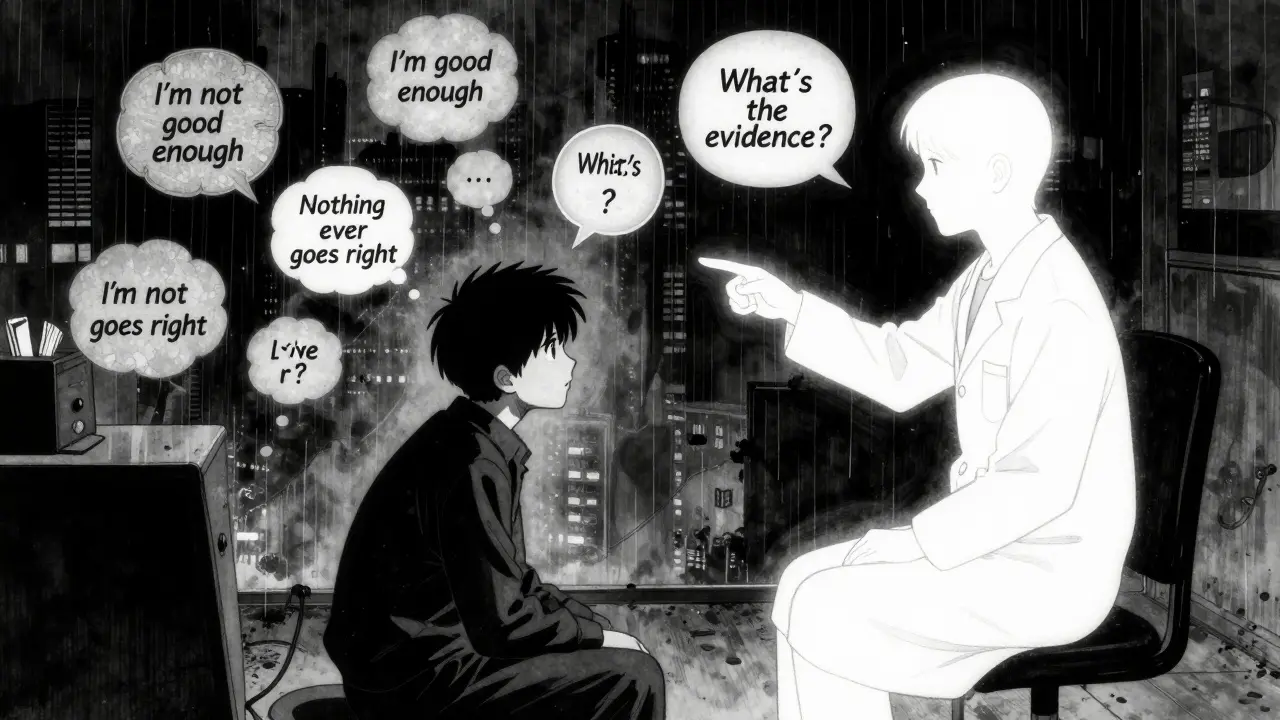
If you’ve ever felt stuck in a loop of negative thoughts - like "I’m not good enough" or "Nothing ever goes right" - and those thoughts are keeping you from sleeping, working, or even leaving the house, you’re not alone. Millions of people struggle with this. And there’s a well-researched, practical solution that’s been helping people for over 60 years: cognitive behavioral therapy, or CBT.
Unlike talk therapies that dig deep into childhood or past trauma, CBT is focused on today. It asks: What are you thinking right now? What are you doing about it? And how can you change it? The goal isn’t to feel better instantly. It’s to learn skills you can use for life.
How CBT Works: Your Thoughts Shape Your Life
CBT is built on a simple but powerful idea: your thoughts affect your feelings, which affect your behavior. It’s not the situation itself that hurts you - it’s how you interpret it.
Imagine you’re at work and your boss doesn’t say hello. One person thinks, "They’re mad at me. I must have messed up." They feel anxious, avoid their boss, and start overworking to prove themselves. Another person thinks, "They’re probably just stressed. I’ll check in later." They feel calm, keep working, and even offer help.
CBT helps you spot the first kind of thinking - the automatic, distorted thoughts that fuel anxiety, depression, or anger. These aren’t just "negative" thoughts. They’re often inaccurate. CBT teaches you to question them.
Psychiatrist Aaron T. Beck first noticed this in the 1960s. He saw that people with depression didn’t just feel sad - they had a pattern of thinking: "I’m worthless," "The world is against me," "The future is hopeless." He called this the cognitive triad. And he proved that changing these thoughts could change how people felt.
The Eight Core Tools of CBT
CBT isn’t one technique. It’s a toolkit. Therapists use eight main strategies, all backed by decades of research:
- Identifying cognitive distortions - like "catastrophizing" ("If I fail this test, my life is over") or "mind reading" ("They think I’m weird").
- Challenging automatic negative thoughts - asking, "What’s the evidence for this? What’s another way to see it?"
- Modifying core beliefs - digging deeper than surface thoughts to change long-held beliefs like "I’m unlovable" or "I have to be perfect to be accepted."
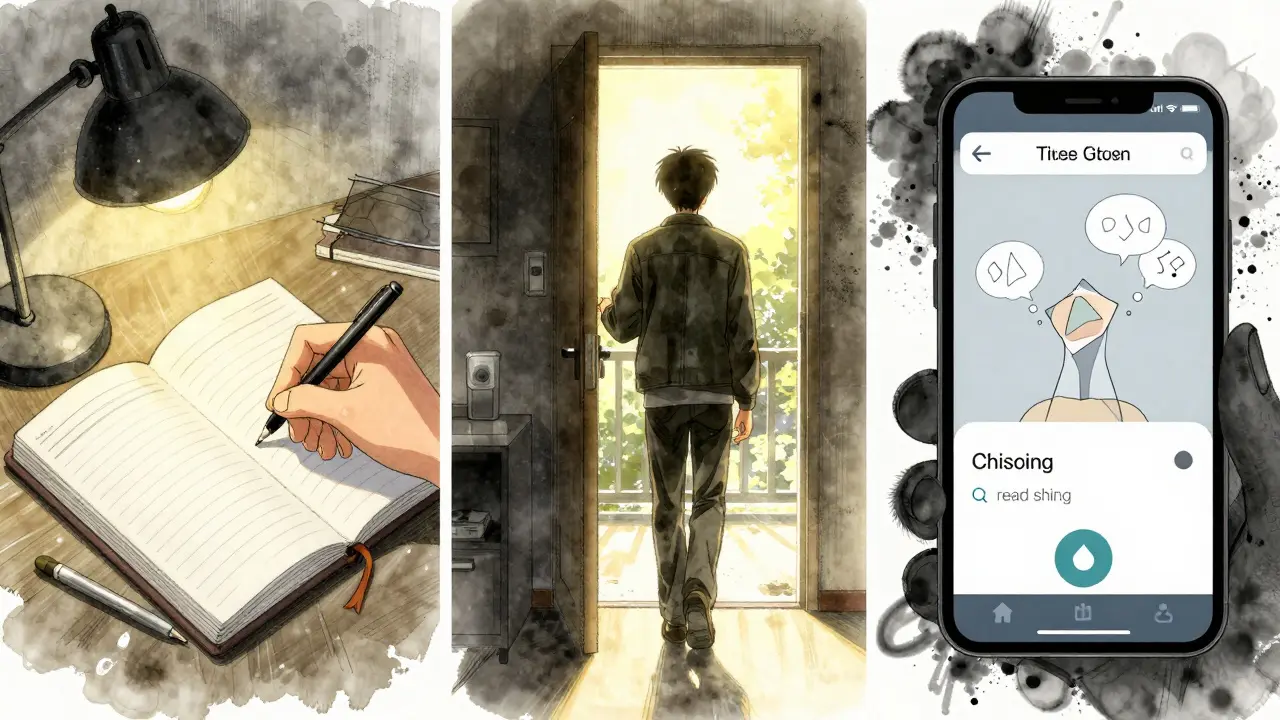
- Behavioral activation - getting moving again. Depression drains energy. CBT helps you schedule small, meaningful activities to rebuild momentum.
- Exposure techniques - facing fears slowly and safely. For someone with social anxiety, this might mean starting with saying "hi" to a neighbor, then a coworker, then speaking up in a meeting.
- Skills training - learning communication, assertiveness, or relaxation techniques to handle tough situations.
- Relapse prevention planning - figuring out what might trigger a return to old patterns, and how to handle it.
- Homework assignments - CBT isn’t just during sessions. You practice skills between appointments. It’s like physical therapy for your mind.
Each session lasts 45 to 60 minutes. Most people attend 12 to 20 sessions total. That’s it. No years of therapy. No endless analysis.
What CBT Works For - And What It Doesn’t
CBT isn’t magic. But it’s one of the most effective treatments we have - and we know that because of science.
Over 2,000 randomized controlled trials have been done on CBT since 1977. That’s more than any other therapy. The National Institute for Health and Care Excellence (NICE) in the UK recommends it as a first-line treatment for:
- Depression
- Anxiety disorders (generalized anxiety, panic, social anxiety)
- Post-traumatic stress disorder (PTSD)
- Obsessive-compulsive disorder (OCD)
- Eating disorders
- Insomnia
- Chronic pain
For depression, CBT matches antidepressants in effectiveness - but with lower relapse rates. One study found that after 12 months, 52% of people who did CBT were in remission, compared to 47% on medication. And when they stopped treatment, only 24% of the CBT group relapsed, while 52% of the medication group did.
For anxiety? CBT beats other therapies. A 2012 meta-analysis found CBT had effect sizes of 0.77 to 1.14 - higher than other talk therapies.
But CBT isn’t perfect. It doesn’t work as well for:
- Severe trauma with complex PTSD - here, therapies like Dialectical Behavior Therapy (DBT) often do better.
- Children with serious behavioral issues - Parent-Child Interaction Therapy (PCIT) shows stronger results.
- People with severe cognitive impairment or acute psychosis - CBT requires thinking clearly and doing homework, which isn’t possible for everyone.

Real People, Real Results
Numbers don’t tell the whole story. Real people share what works.
One user on HealthUnlocked said graded exposure for social anxiety cut their panic attacks from 15 a week to 2. Another, with OCD, went from spending 4 hours a day washing hands to zero after 18 sessions of Exposure and Response Prevention - a CBT technique.
On Reddit’s r/mentalhealth, 78% of 1,420 posts about CBT were positive. People loved "thought records" - writing down situations, thoughts, and emotions to see patterns. "It felt like I was finally seeing my own mind," one person wrote.
But it’s not easy. CBT asks you to do work. Homework. Facing fears. Challenging beliefs that feel true. That’s why 32% of negative reviews mention frustration with assignments. And 27% say exposure exercises were emotionally hard at first.
The NHS surveyed 15,000 people who got CBT. 74% completed treatment. 68% said their symptoms improved. But for people with addiction on top of anxiety or depression, completion dropped to 58% - showing how complex mental health can be.
How to Get Started
You don’t need a referral to start CBT. In the UK, you can self-refer to NHS Talking Therapies. In the US, many insurance plans cover it. Private therapists typically charge £80-£150 per session.
But not all therapists are trained the same way. Look for someone certified by the Academy of Cognitive Therapy or trained by the Beck Institute. They’ve done 120-180 hours of training and supervised cases.
There are also digital tools. Apps like Woebot (FDA-cleared in 2021) use CBT principles to guide users through thought records and behavioral exercises. They’re not replacements for therapy - but they help between sessions or if you can’t access a therapist.
Free resources exist too. The National Alliance on Mental Illness (NAMI) offers downloadable CBT workbooks. Many libraries have them. YouTube has guided exercises. You can start learning today.
The Future of CBT
CBT isn’t stuck in the past. It’s evolving.
"Third-wave" CBT adds mindfulness and acceptance. Acceptance and Commitment Therapy (ACT) helps people live with pain instead of fighting it. For chronic pain, ACT shows 15% better results than traditional CBT.
Researchers are now using AI to analyze thought records in real time. Imagine an app that notices you’re using "all-or-nothing" thinking and gently asks, "Is that really true?"
The National Institute of Mental Health is testing "precision CBT" - matching treatment to brain patterns, not just symptoms. In 5-7 years, we might see CBT tailored to your biology.
But the core hasn’t changed. CBT works because it gives people control. It doesn’t promise quick fixes. It gives you tools. And tools last.
Is CBT Right for You?
Ask yourself:
- Do you want to change how you think and act - not just understand why you feel this way?
- Are you willing to do homework and practice skills outside of sessions?
- Do you have the mental capacity to reflect on your thoughts and challenge them?
If yes - CBT could be the most useful thing you do for your mental health this year.
If you’re unsure, try a free CBT workbook. Or talk to your GP. You don’t have to commit to 12 sessions to start learning. Just one step - one thought record - can begin to shift everything.




Stephon Devereux
February 12, 2026 AT 10:20CBT is the closest thing we have to a mental health Swiss Army knife. It doesn't promise miracles but it gives you actual tools you can use when your brain goes full meltdown mode. I used to think therapy meant lying on a couch crying about my mom for years. Turns out it's more like learning to fix your own software instead of waiting for someone else to reboot you.
The homework thing is weird at first. Writing down thoughts feels silly until you realize you've been running the same corrupted script on loop for a decade. Thought records? Yeah they're tedious. But they work. Like brushing your teeth. You don't enjoy it but you feel better afterward.
And the fact that it beats meds on relapse rates? That's huge. Medication treats symptoms. CBT rewires the damn operating system.
Steve DESTIVELLE
February 12, 2026 AT 22:03The entire framework rests on the assumption that thought is primary and reality secondary which is a metaphysical error of the highest order
When we reduce human suffering to cognitive distortions we ignore the material conditions that produce them
Capitalism creates anxiety not because we think poorly but because we live under constant precarity
Depression isn't a misfire in the prefrontal cortex it's a rational response to a world that systematically grinds people into dust
CBT is the therapy of the neoliberal age because it asks you to fix yourself instead of the system
It's brilliant as a bandaid but dangerous as a cure
Why are we so eager to individualize structural pain
We treat the symptom because the disease is too big to name
And yet millions still find relief which makes the contradiction all the more painful
I want change not just adjustment
But I also know that when you're in the pit you'll grab any rope they throw you
So I'm not against CBT I'm against the world that makes CBT necessary
And yes I know I'm overthinking this
And yes I know that's probably a cognitive distortion
Ernie Simsek
February 13, 2026 AT 14:38Bro this is why I love CBT so hard 🤯
I went from crying in the shower every morning to doing 5-min thought records during my commute
My therapist called me a CBT ninja and I took it as a compliment 😎
Exposure therapy for my social anxiety? Brutal at first but now I say hi to cashiers without wanting to die
And Woebot? Best bot I've ever talked to 🤖💙
Stop overthinking the philosophy and just DO THE WORK
Life isn't a TED Talk it's a gym
Sweat. Reps. Progress.
CBT is the squat rack of mental health
And yeah I know I'm using too many emojis but I'm happy
Craig Staszak
February 15, 2026 AT 10:44I did 16 sessions of CBT last year after my panic attacks got bad
It wasn't magic but it was the first thing that actually stuck
I still use the thought record template I printed out
Now I catch myself before I spiral into "I'm going to lose my job" mode
It's not about positive thinking it's about accurate thinking
My boss didn't reply to my email
That doesn't mean she hates me
It means she's probably drowning in meetings
Small shift huge difference
And the homework? Yeah it felt forced at first
But now I do it without thinking
Like brushing teeth
CBT didn't fix me
It gave me the tools to fix myself
That's worth more than any pill
Robert Petersen
February 17, 2026 AT 02:01For anyone thinking about trying CBT I want you to know this
You don't have to be perfect at it
You don't have to write perfect thought records
You don't have to face every fear on day one
Progress isn't linear
Some days you'll do the homework
Some days you'll just survive
And that's okay
I used to think I was failing because I still felt anxious after a session
Turns out that's normal
CBT doesn't erase pain
It teaches you how to carry it differently
You're not broken
You're learning
And that takes courage
So if you're on the fence
Start small
One thought record
One deep breath
One step
You've already done more than you think
Joanne Tan
February 17, 2026 AT 20:56so i tried cbt and honestly i was skeptical like wtf is this gonna do
but then i started doing the thought records
and like
turns out i was catastrophizing everything
my boss said "hi" and i thought "she hates me"
but then i looked at the evidence
she said hi to everyone else too
and i was like
oh
huh
so i did it again
and again
and now i catch myself before i spiral
its not magic
but its the first thing that made me feel like i had control
also homework is annoying
but worth it
Stacie Willhite
February 18, 2026 AT 16:37I used to think CBT was too clinical
Too robotic
Too focused on fixing thoughts instead of feeling them
Then I started seeing clients who were stuck in the same loops
And I watched them slowly, painfully, shift
Not because they were forced to think positively
But because they learned to notice their thoughts without being ruled by them
That's the real gift
Not fixing
But witnessing
And choosing
One small choice at a time
CBT doesn't erase trauma
It gives space between the trigger and the reaction
And that space? That's where healing begins
So if you're hesitating
Don't wait for perfect
Just start
One sentence
One breath
One day
alex clo
February 19, 2026 AT 11:57athmaja biju
February 20, 2026 AT 08:35India has 150 million people with mental health issues and only 9000 psychiatrists
CBT is a Western luxury
Who has time to write thought records when you're working two jobs to feed your family
Who cares about cognitive distortions when your landlord raises rent again
This article reads like a Silicon Valley ad
CBT for the privileged
For the ones who can afford to sit and think
While the rest of us just survive
Don't tell us to challenge our thoughts
Challenge the system
That's where the real work begins