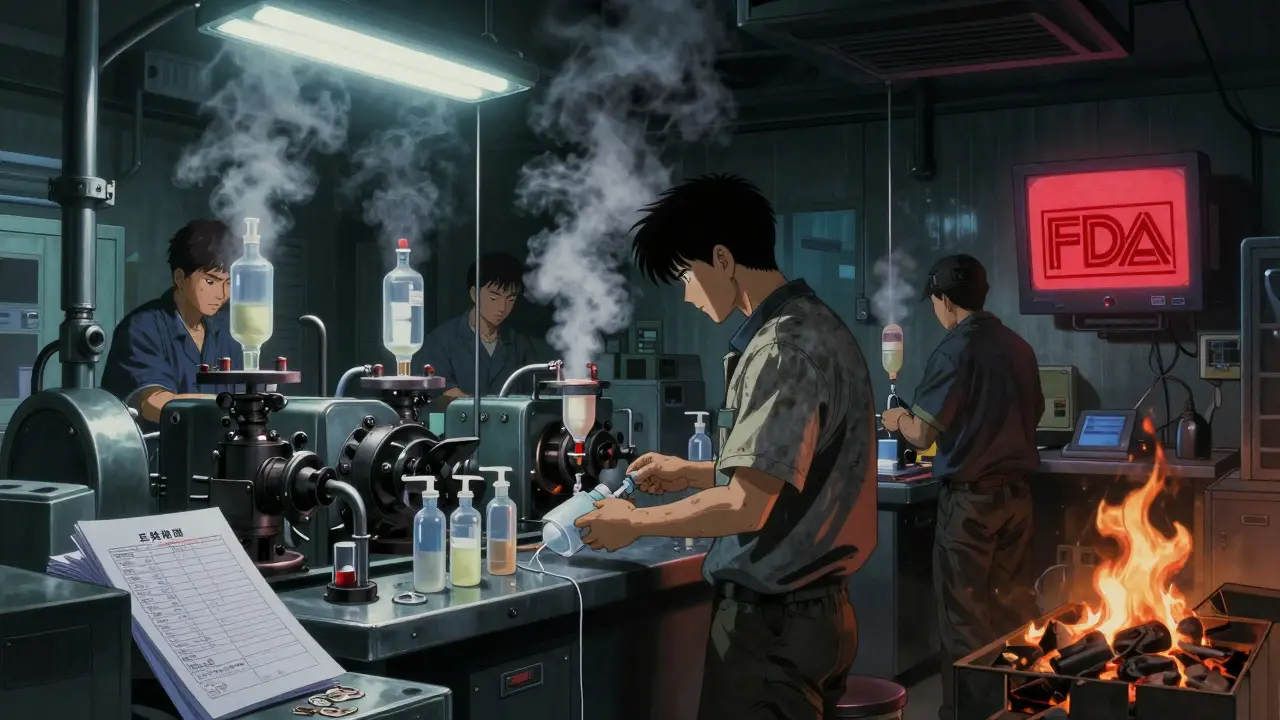
When you buy a pill, a medical device, or even a children’s toy made overseas, you assume it’s safe. But the truth is, foreign manufacturing quality is slipping-and the risks are no longer theoretical. In 2025, the FDA flagged more than 47% of Chinese drug factories for serious quality violations. That’s nearly half of all inspected sites. And it’s not just China. From India to Vietnam, the pattern is the same: cheaper labor, weaker oversight, and corners being cut. For companies relying on overseas production, the cost of a single quality failure can be millions in recalls, lawsuits, or worse-lives lost.
Why Quality Is Falling in Overseas Factories
The dream of cheaper production led companies to move factories to countries with lower wages. But cost savings don’t come without trade-offs. Many overseas suppliers lack the infrastructure, training, or incentive to meet Western standards. In China, the government launched “Made in China 2025” to upgrade quality, but the reality on the ground tells a different story. According to Harris Sliwoski’s 2025 report, manufacturing risks have shifted from simple mistakes to deliberate fraud. Suppliers are replacing medical-grade silicone with industrial-grade plastic. They’re falsifying test results. They’re hiding contamination because they can’t afford to scrap batches. The FDA’s inspection data shows how deep this goes. In 2024, 68% of inspected Chinese facilities were caught substituting raw materials. In 42%, critical manufacturing processes weren’t properly validated. And in nearly 30%, documents were forged to pass audits. These aren’t accidents. They’re survival tactics. When a factory is under financial pressure and has no real consequences for cutting corners, they’ll do it.The Double Standard in Inspections
Here’s the kicker: most inspections in China are announced in advance. The FDA tells factories when they’re coming. That gives suppliers days-or even weeks-to clean up, hide problems, and prep fake records. Brookings Institution found that 78% of FDA inspections in China were scheduled through 2024. In the U.S., only 5% of inspections are announced. That’s not oversight. That’s a loophole. Compare that to the EU’s system. Every batch of medicine shipped into Europe must be certified by a local Qualified Person (QP)-a licensed professional who takes personal legal responsibility. If something goes wrong, they’re on the hook. That’s why EU-manufactured drugs have 22% fewer quality failures than imports from countries without similar rules. The U.S. doesn’t have that. And it’s costing lives.Real Cases, Real Consequences
In early 2025, Wuhu Nuowei Chemistry Co. in China received an FDA warning letter for letting impurities exceed U.S. safety limits by over 300%. Their batches made it into American pharmacies before being pulled. That’s not rare. In 2024, foreign manufacturers were responsible for 62% of all drug recalls in the U.S., even though they only produced 43% of the total volume. One Reddit user from Minnesota shared how a Shenzhen supplier swapped medical-grade silicone in a respiratory device with cheap industrial-grade material. The result? 12,000 units failed biocompatibility tests. The company lost $2.4 million in recalls, legal fees, and brand damage. Another case involved a German medical device firm that got hit with a $1.2 million claim from Sinosure-China’s export credit agency-after receiving substandard parts. The agency sided with the supplier, not the buyer. These aren’t outliers. They’re symptoms of a broken system.
Who’s Getting It Right?
Some companies are fighting back-and winning. A Minnesota-based medical device maker implemented what they call the “China-specific quality triad”: a local quality manager on-site, blockchain-based traceability for every component, and third-party audits done without notice. Between 2023 and 2025, their defect rate dropped from 12.7% to 0.8%. That’s not luck. That’s strategy. They didn’t just hire a factory. They built a system. They trained staff. They installed real-time sensors on production lines. They required suppliers to share data directly with their quality team-not through middlemen. They spent $18,500 per year per facility on training. And they made contracts so specific that vague terms like “meet international standards” were replaced with exact numbers: “impurity levels must not exceed 0.05%,” “batch temperature must be logged every 15 minutes,” “all materials must come with COAs from certified labs.”The Hidden Costs of Cheap Production
Many companies think overseas manufacturing saves 30-45% on labor. That’s true-if everything goes perfectly. But when quality fails, the real cost spikes. Harris Sliwoski estimates that unaddressed quality issues add 15-25% to total manufacturing costs through rework, shipping delays, recalls, legal fees, and lost sales. One recall can wipe out years of savings. And it’s getting worse. The FDA announced in May 2025 that it will increase unannounced inspections to 40% of foreign sites by the end of 2025, and 75% by 2027. That means factories can’t just clean up before an audit anymore. They’ll need to be clean every day. Companies that haven’t invested in real quality systems will be caught off guard-and face shutdowns, import bans, or worse.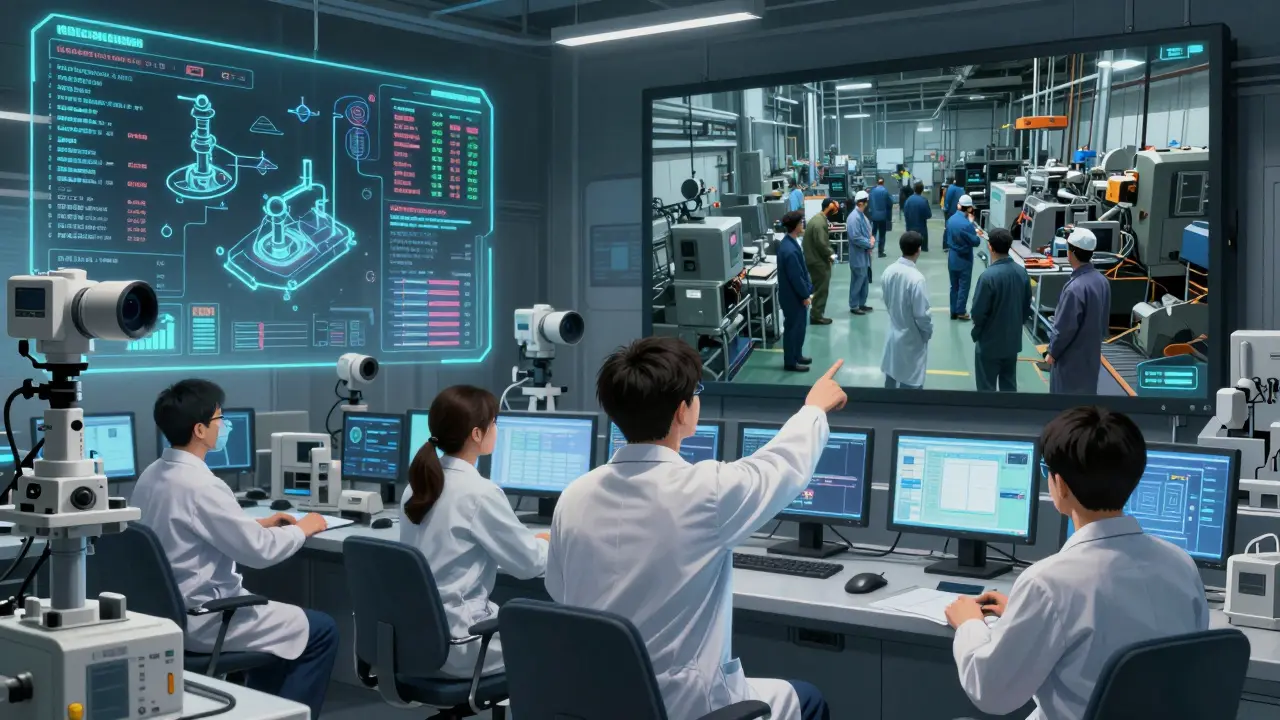
What You Need to Do Now
If you’re sourcing from overseas, here’s what you must do:- Don’t trust paper audits. Visit factories unannounced. Show up on a Tuesday morning, not a Friday afternoon.
- Require direct access to quality personnel. Talk to the lab techs, not just the manager. Ask to see their training records.
- Use real-time monitoring. AI-powered visual inspection systems detect 99.2% of defects-compared to 85-90% for human inspectors. Only 22% of Chinese factories use them. Be one of the few who do.
- Build blockchain traceability. Every component, every batch, every test result should be digitally recorded and tamper-proof.
- Contractually lock in quality metrics. No vague terms. Define acceptable impurity levels, temperature ranges, material grades, and penalties for non-compliance.
- Invest in training. Spend at least $18,500 per year per facility on quality training for your local team and supplier staff.
The Future Is Not Cheaper-It’s Cleaner
The era of “buy cheap, fix later” is over. The FDA, regulators, and consumers are waking up. Companies that treat overseas manufacturing as a cost center will fail. Those that treat it as a quality-critical operation will survive-and thrive. The global market for manufacturing quality assurance is projected to hit $14.3 billion by 2027. That’s not because people want to spend more. It’s because they have no choice. The cost of ignoring quality is too high. If you’re still relying on old-school inspections, vague contracts, and trust-based relationships-you’re gambling. And the house always wins.Why are foreign manufacturing quality issues getting worse in 2026?
Quality issues are worsening because many overseas suppliers face financial pressure and lack real consequences for cutting corners. While governments like China’s promote quality upgrades through initiatives like Made in China 2025, enforcement is inconsistent. At the same time, unannounced inspections remain rare in key regions like China, allowing factories to hide problems. The result is a rise in deliberate fraud-material substitution, falsified test results, and hidden contamination-that’s harder to catch than simple mistakes.
Which countries have the worst manufacturing quality problems?
China leads in the number of FDA violations, with 47% of inspected drug facilities receiving Form 483 observations in 2024-far higher than the 29% for U.S. sites and 33% for European ones. India also struggles, accounting for 34% of FDA drug import alerts despite making up only 25% of foreign facilities. Vietnam has shown improvement since 2022, but quality remains inconsistent. The real issue isn’t geography-it’s oversight. Countries without mandatory certification systems or unannounced inspections have the highest failure rates.
What’s the most common type of quality failure in overseas factories?
Material substitution is the most common issue, found in 68% of inspected Chinese facilities. Suppliers replace expensive, regulated materials (like medical-grade silicone or pharmaceutical-grade chemicals) with cheaper, non-compliant alternatives. Other top failures include inadequate process validation (42% of cases) and falsified documentation (29%). These aren’t random errors-they’re calculated decisions to save money at the risk of safety.
How can I protect my business from overseas quality failures?
Start with three actions: 1) Conduct unannounced factory visits with direct access to quality staff, 2) Use blockchain or IoT systems to track materials and test results in real time, and 3) Write contracts with exact, measurable quality standards-not vague phrases like “meet international standards.” Invest in training ($18,500/year/facility), hire local quality managers, and partner with third-party auditors who have no financial tie to the supplier. Don’t rely on paper certificates-verify everything on the ground.
Is it better to manufacture locally instead of overseas?
Not necessarily-but you need to weigh the risks. Local manufacturing usually means better oversight, faster response to issues, and fewer hidden costs from recalls. But it’s more expensive upfront. The smarter approach is to choose overseas partners only if you’re willing to invest in robust quality systems. Many companies are now shifting to “friend-shoring”-moving production to allied countries like Mexico, Poland, or India-but that doesn’t fix the problem if quality controls aren’t in place. Location matters less than accountability.
What role does AI play in improving overseas quality control?
AI-powered visual inspection systems can detect defects with 99.2% accuracy-far better than human inspectors, who average 85-90%. These systems use cameras and machine learning to spot tiny cracks, misalignments, or contamination that the human eye misses. But only 22% of Chinese manufacturers have adopted them as of mid-2025. Companies that do use AI see defect rates drop by 33% within a year. The technology isn’t magic-it’s a tool. It works best when combined with trained staff, real-time data, and strict protocols.
How will new FDA rules affect foreign manufacturers in 2026?
The FDA is shifting to “parity inspections,” meaning foreign factories will be inspected with the same rules as U.S. ones-no advance notice, same sampling methods, same penalties. By 2027, 75% of foreign inspections will be unannounced. This will force factories to maintain quality every day, not just before audits. Expect compliance costs to rise 18-25% for affected manufacturers. Companies that haven’t upgraded their systems will face import bans, product seizures, or even criminal charges for fraud.
Can I trust certifications like ISO 9001 for overseas suppliers?
ISO 9001 is a baseline, not a guarantee. Many factories in China and India hold ISO certification but still commit serious violations. The certification process is often a formality-some auditors are paid by the supplier and have no real authority. Always verify certification with the issuing body and cross-check with FDA warning letters or inspection histories. Treat ISO as a starting point, not proof of quality. Real assurance comes from on-site audits, real-time data, and direct oversight-not a sticker on a wall.



Jose Mecanico
January 11, 2026 AT 17:19Been working with a supplier in Vietnam for our medical sensors. We did unannounced visits and installed IoT sensors on the assembly line. Defects dropped from 9% to 0.4% in 8 months. It’s not cheap, but it’s cheaper than a recall. Trust but verify, and verify again.
Also, their QA lead is now on Slack with our team. Real-time alerts when a batch goes off-spec. Game changer.
Alex Fortwengler
January 11, 2026 AT 18:47Of course the FDA’s ‘inspections’ are rigged. They’re paid by the same corporations that outsource to these factories. You think they want to shut down 70% of China’s pharma output? That’d crash the market and make Big Pharma lose billions. This whole thing’s a scam to scare small companies into paying for ‘quality consultants’ who just take your money and send you another PDF.
And don’t get me started on blockchain. It’s just a buzzword. No one’s tracking a damn pill from factory to shelf. It’s all theater.
jordan shiyangeni
January 13, 2026 AT 17:37Let’s be absolutely clear: the entire global supply chain for pharmaceuticals and medical devices has been corrupted by profit-driven negligence, and the regulatory bodies are either complicit or incompetent. The fact that 68% of inspected Chinese facilities were caught substituting materials is not a statistical anomaly-it is the inevitable result of a neoliberal economic model that prioritizes shareholder returns over human life.
When you outsource production to a country where labor is cheap and oversight is non-existent, you are not ‘saving money’-you are externalizing risk onto the most vulnerable: the elderly, children, immunocompromised patients who rely on these products. And now we’re being told to ‘invest in blockchain’ as if that’s a moral solution rather than a technological Band-Aid on a systemic wound.
ISO 9001? A joke. A sticker. A placebo. The only real accountability is legal liability-personally, criminally, and financially-for the executives who approved these supply chains. Until we jail the CEOs who chose profit over safety, this will never change.
And yes, I’ve read the FDA’s 2025 report. I’ve cross-referenced the warning letters with the FDA’s own inspection logs. The data is horrifying. And yet, Congress hasn’t passed a single bill to enforce parity inspections. Why? Because Big Pharma donates millions to both parties. This isn’t about safety. It’s about power.
Abner San Diego
January 14, 2026 AT 23:39USA first. Why are we letting China make our pills? We used to make everything here. Now we’re trusting some guy in a factory with no gloves to pour chemicals into capsules? That’s not globalization-that’s national suicide.
And don’t give me that ‘friend-shoring’ crap. India’s worse. Vietnam’s a mess. Mexico? Half their inspectors are on the payroll of the factories.
Bring it home. Or ban imports. Simple.
Eileen Reilly
January 16, 2026 AT 18:32ok so i just read this whole thing and im like… yessss but also… why does no one talk about how the factories are being squeezed by the buyers? like, the US companies demand lower prices every year, then act shocked when the supplier swaps silicone for plastic? its a system designed to fail.
also i saw a doc on netflix about this and the guy who ran the factory said they were told to ‘meet specs’ but no one ever told them what the specs actually were. just ‘do it like last time.’
also why is everyone so obsessed with blockchain? its not magic. its just a ledger. if the input data is fake, the blockchain just makes the lie look fancy.
Monica Puglia
January 17, 2026 AT 15:48This is so important 🙏
My cousin works in QA for a med device company in Ohio-they switched from a Chinese supplier to a Polish one last year. Same price. Better quality. No drama. They do surprise audits every 3 weeks. And the Polish team actually sends video updates of the lab testing. It’s wild how much better communication is when you’re not 12 hours behind and dealing with 3 layers of middlemen.
Also, training? YES. They spent $20k on a 2-day bootcamp for the supplier’s engineers. Now the defect rate is lower than their old US plant. Who knew?
Don’t just cut costs. Invest in relationships. 😊
Rebekah Cobbson
January 17, 2026 AT 21:21One thing people overlook: the people working in these factories aren’t villains. They’re parents, siblings, workers trying to feed their families. The system is broken-not them.
But that doesn’t excuse the companies that demand lower prices while ignoring the human cost. We need to treat suppliers like partners, not vendors. Pay fairly. Train them. Hold them accountable with respect, not threats.
And yes, unannounced visits work. I’ve done them. The difference between a ‘prepared’ factory and a real one is night and day. You smell it. You see it in the eyes of the workers.
It’s not about fear. It’s about integrity.
Craig Wright
January 18, 2026 AT 23:49It is deeply concerning that the United States continues to outsource its most vital medical supply chains to nations with no legal tradition of product liability. The EU’s Qualified Person model is not merely bureaucratic-it is a moral imperative. The British regulatory framework, which mandates direct accountability of local certifiers, is the only defensible approach. American corporations are not merely negligent-they are abdicating their duty of care to foreign entities with no legal or ethical obligation to the Western consumer. This is not globalization. This is corporate cowardice.
Rinky Tandon
January 19, 2026 AT 15:13Let me tell you something about Indian pharma-they’re not just cutting corners, they’re running marathons with the finish line in a landfill. I’ve seen it. I’ve audited three plants in Hyderabad. The ‘quality manager’ was the owner’s nephew who graduated from a diploma mill. The HPLC machine? Out of calibration since 2021. The COAs? Printed from a template in Word. And guess what? The FDA gave them a ‘warning’ and they kept shipping.
And don’t get me started on the ‘local QP’ nonsense. In India, the QP is a consultant who signs 500 certificates a month for $50 each. They don’t even know what batch they’re certifying.
It’s not a supply chain. It’s a Ponzi scheme with pills.
Ben Kono
January 20, 2026 AT 16:37AI inspection is the future. We installed a system from a startup in Austin. It caught a batch of 300 defective syringes because the needle alignment was off by 0.02mm. Human inspectors missed it. The factory said it was ‘within tolerance.’ The AI said no. We stopped the shipment. Saved $1.2M. The vendor still hasn’t paid us back.
But it works. Just do it.
Cassie Widders
January 22, 2026 AT 10:55I used to work in a factory in Guangdong. We got 3 days’ notice before every ‘inspection.’ We’d scrub the floors, hide the bad batches in the basement, print fake logs. Everyone knew it. The auditors knew it. The buyers knew it. We just all pretended it was real.
Now they’re doing unannounced visits? Good. I hope it burns the whole thing down.
Konika Choudhury
January 23, 2026 AT 12:43why do americans think theyre so special we make better stuff here? your quality is garbage too. you just dont hear about it because you dont test your own stuff as much. we make 90 of the worlds antibiotics and you still buy them. so shut up
Darryl Perry
January 24, 2026 AT 22:33Unannounced inspections are non-negotiable. Period. Any supplier that resists them should be immediately terminated. No exceptions. No negotiations. If they can’t operate cleanly without warning, they’re not fit to produce for Western markets. The data is clear. The risk is existential. Act accordingly.