
Have you started a new medication and noticed your hair thinning out? You’re not alone. Every year, hundreds of thousands of people in the U.S. experience hair loss triggered by something they’re taking for another condition. It’s not just about looks-it’s about confidence, daily routines, and even mental health. The good news? Most of the time, this type of hair loss is temporary, and there are real, science-backed ways to manage it.
How Medications Cause Hair Loss
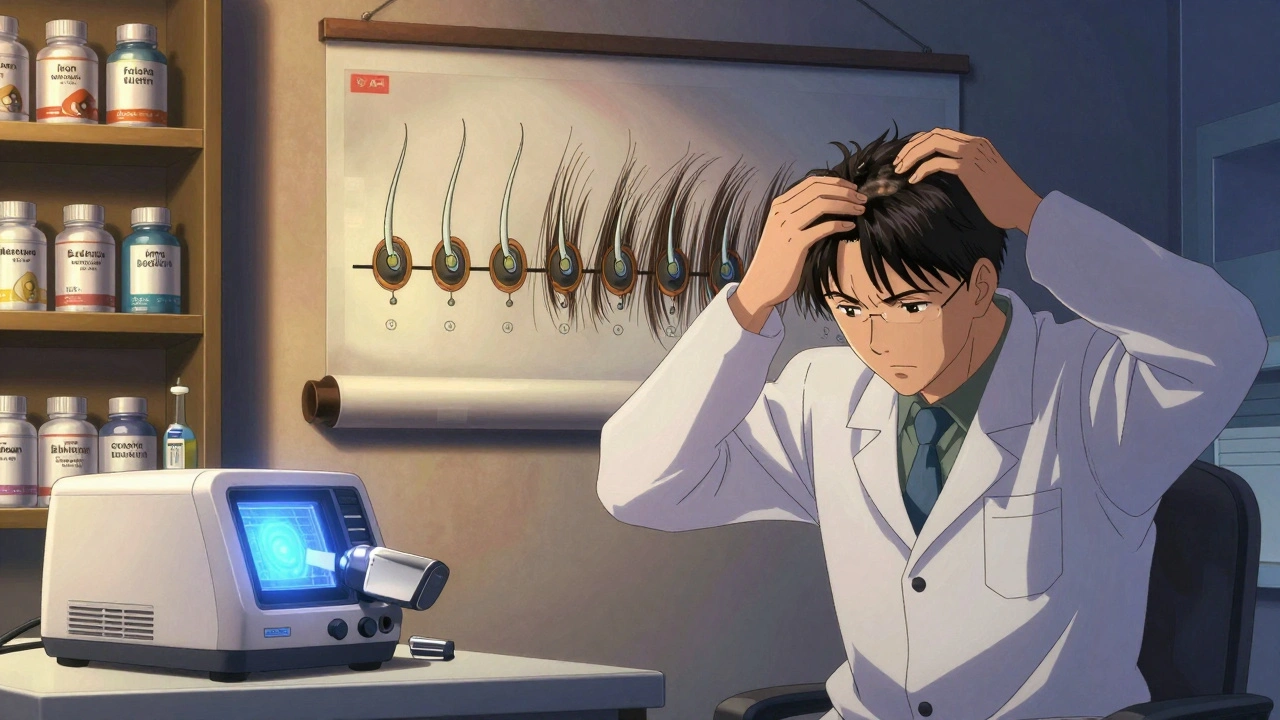
Not all hair loss is the same. When a drug causes hair to fall out, it’s usually messing with one of two phases in your hair’s natural cycle: telogen effluvium or anagen effluvium.Telogen effluvium is the most common. It happens when your hair follicles get pushed into a resting phase too early. Instead of growing, they stop-and then shed. This usually shows up 2 to 4 months after you start a new medication. You might notice more hair in your brush, shower drain, or on your pillow. It’s not patchy. It’s diffuse-your whole scalp feels thinner. This is how drugs like blood pressure meds, antidepressants, and even some arthritis pills cause hair loss.
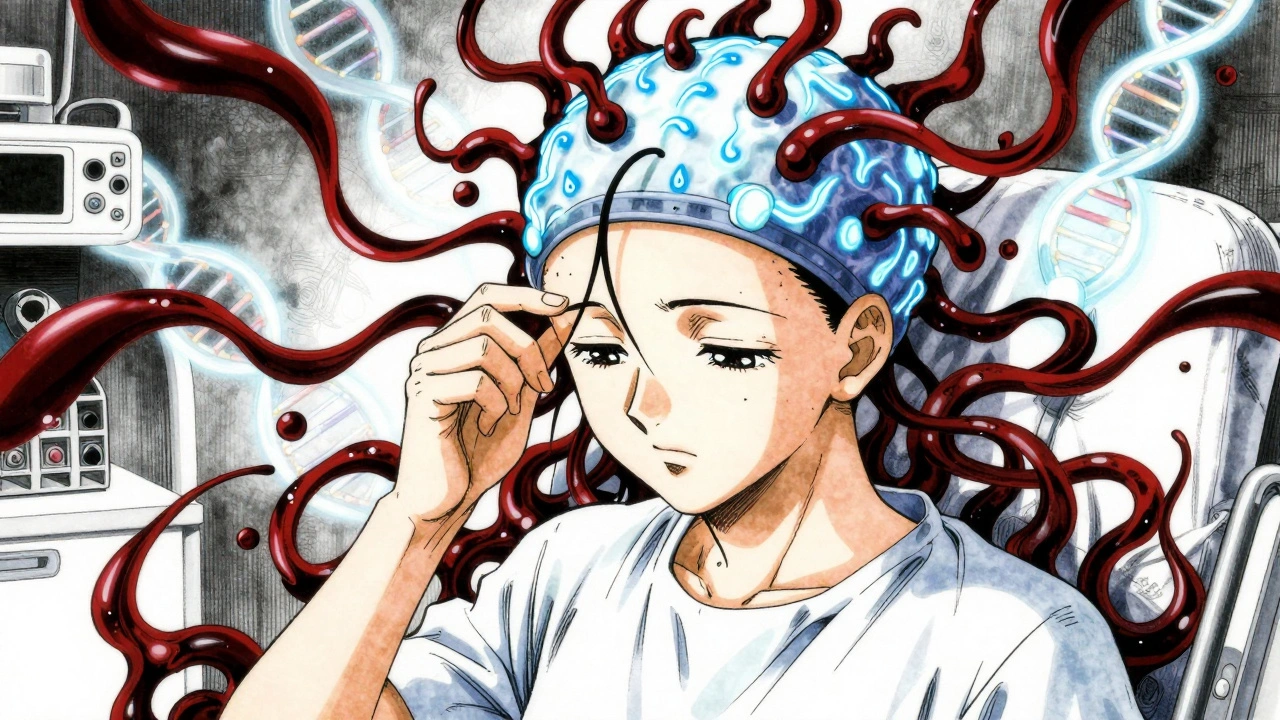
Anagen effluvium is different. It hits fast and hard. This happens when the drug directly attacks the hair follicle while it’s actively growing. That’s why chemotherapy causes such dramatic hair loss within days. Up to 65% of people on chemo lose most of their hair. The follicles don’t just rest-they get damaged. But here’s the twist: once chemo stops, hair usually grows back quickly, sometimes in 3 to 6 weeks. The texture might change-curlier, finer, or a different color-but it grows.
Which Medications Are Most Likely to Cause Hair Loss?
Some drugs are far more likely to trigger this side effect than others. Here’s what the data shows:- Antidepressants (like sertraline, fluoxetine, paroxetine): Affect 5-7% of users. Often causes telogen effluvium.
- Blood pressure meds (beta-blockers, ACE inhibitors): Around 1-3% of users report shedding.
- Arthritis drugs (methotrexate, leflunomide): Methotrexate causes hair loss in 1-3% of users; leflunomide in up to 10%.
- Oral retinoids (like isotretinoin for acne): Affects nearly 18% of users. Can be stubborn to reverse.
- Chemotherapy drugs: Nearly two-thirds of patients lose significant hair. This is anagen effluvium at its worst.
It’s not about the drug alone-it’s about your genes, your body’s sensitivity, and how long you’ve been on it. Some people take the same pill for years with no issue, then suddenly start shedding. That’s because hair follicles are incredibly sensitive to chemical changes. Even small shifts in hormone levels or nutrient absorption can tip them over the edge.
What You Can Do Right Now
The first step? Don’t panic. And don’t stop your medication on your own. Talk to your doctor. But while you wait for that appointment, here’s what actually works.Give it time. For telogen effluvium, 85% of cases fix themselves within 6 months after stopping the drug. That’s the rule. If you started a new pill 3 months ago and now your hair is thinning, wait another 3 months before trying anything else. Your body needs time to reset.
Try minoxidil. This is the gold standard for non-chemo hair loss. A 5% solution applied twice daily to the scalp can improve hair density by 40-50% after 6 months. It’s not magic-it’s science. But here’s the catch: 89% of users experience a temporary increase in shedding during weeks 2-8. That’s normal. It means the drug is waking up dormant follicles. Stick with it. If you quit because of the initial shedding, you’ll never see the results.
Consider low-level laser therapy. Devices like the iRestore Elite 780 or Capillus82 are FDA-cleared and backed by clinical trials. You need to use them daily for 20-30 minutes. Results show up after 26 weeks, but 65-90% of users report measurable improvement. It’s not cheap, but it’s non-invasive and has almost no side effects.
Supplements That Help (and the Ones That Don’t)
You’ll see ads for every kind of hair vitamin under the sun. But not all of them work.- Biotin (5,000 mcg/day): Helps if you’re deficient. Most people aren’t. It won’t regrow hair if you’re getting enough from your diet.
- Zinc (15 mg/day): Important for hair growth. Deficiency is rare, but if your ferritin is low, zinc can help.
- Iron: If your ferritin level is below 70 ng/mL, supplementing can reduce shedding. Get tested first.
- Folic acid: If you’re on methotrexate, taking 1 mg daily can reduce hair loss by 25%. This one’s proven.
- Nutrafol and similar blends: These contain marine collagen, ashwagandha, and curcumin. In Amazon reviews, 63% of users report visible improvement after 6 months. Not a cure, but a helpful support.
Don’t waste money on “miracle” hair gummies loaded with sugar and unproven herbs. Stick to what’s backed by data.
For Chemotherapy Patients: Scalp Cooling
If you’re undergoing chemo, scalp cooling isn’t optional-it’s a game-changer. Devices like the DigniCap cool your scalp to 15-22°C before, during, and after treatment. This cuts blood flow to the follicles, so the chemo drugs don’t reach them as easily.Studies show 50-65% of breast cancer patients retain significant hair with this method. That’s not just about vanity-it’s about identity, dignity, and mental resilience. Yes, it’s uncomfortable. Patients report 7.2/10 pain levels during the 90-minute sessions. But for many, it’s worth it.
Important: There’s a small risk-0.8%-that cancer cells could hide in the cooled scalp. But current guidelines from ASCO say the benefit far outweighs the risk for most patients.
When to See a Dermatologist
If your hair loss lasts longer than 6 months after stopping the medication, or if you’re losing hair in patches (not just thinning), it’s time to see a specialist. You might have another condition-like alopecia areata or thyroid disease-that’s being masked by the drug.Also, if you’re on a medication that’s working well for your main condition, don’t assume you have to live with hair loss. Your dermatologist can help you weigh options: switch to a different drug, add minoxidil, or use laser therapy while staying on your current treatment.
The Psychological Toll
This isn’t just a physical issue. In a 2023 survey, 82% of people with medication-induced hair loss said it hurt their self-esteem. Nearly half withdrew from social situations. That’s real. Hair is tied to identity, especially for women and older adults.Joining a community like Reddit’s r/HairLoss (with over 247,000 members) can help. People share timelines, product reviews, and emotional support. One user wrote: “I cried every day for 3 months. Then one day, I saw a tiny strand growing back. That’s when I knew I’d be okay.”
You’re not broken. You’re not failing. Your body is reacting to a chemical. And you have options.
What’s Coming Next
Science is moving fast. In 2023, the FDA approved a topical version of finasteride (Breezula) that works as well as the pill but with 90% fewer sexual side effects. Early trials with exosome therapy-using your body’s own healing signals to regrow hair-showed a 30% increase in density after 6 months. And researchers at Mayo Clinic have identified 17 genetic markers that predict who’s most likely to lose hair from certain drugs. Soon, we might be able to test for this before you even start a new medication.The global hair loss treatment market is expected to hit $12.3 billion by 2027. That’s because more people are asking questions-and more doctors are listening.
Final Takeaways
- Most medication-induced hair loss is reversible.
- It takes 2-4 months to start, and 6-12 months to recover after stopping the drug.
- Minoxidil (5% solution, twice daily) is the most effective treatment for non-chemo cases.
- Scalp cooling works for chemo patients-despite the discomfort.
- Supplements like folic acid (with methotrexate) and iron (if ferritin is low) help.
- Don’t quit your meds without talking to your doctor.
- Patience is your best ally. Hair grows slowly, but it grows.
If you’re losing hair after starting a new pill, you’re not alone. And you’re not out of options. With the right approach, your hair will come back-and so will your confidence.
Can medication-induced hair loss be permanent?
In most cases, no. Over 90% of cases caused by drugs like antidepressants, blood pressure meds, or arthritis pills reverse completely after stopping the medication. The only exceptions are rare cases involving long-term use of oral retinoids or severe damage from chemotherapy in people with genetic predispositions. Even then, regrowth often occurs over time.
How long after starting a drug does hair loss begin?
For telogen effluvium (the most common type), shedding typically starts 2 to 4 months after beginning the medication. This delay happens because hair follicles need time to complete their growth cycle before entering the resting phase. For anagen effluvium (like chemo), hair loss can begin within 7 to 14 days.
Does minoxidil work for drug-induced hair loss?
Yes. Minoxidil is the most studied and effective topical treatment for drug-induced hair loss caused by telogen effluvium. Clinical studies show 40-50% improvement in hair density after 6 months of consistent use. It doesn’t reverse the cause, but it helps speed up regrowth and reduces shedding.
Should I stop my medication if I’m losing hair?
No-not without talking to your doctor. Stopping a medication abruptly can be dangerous, especially for conditions like high blood pressure, depression, or autoimmune diseases. Your doctor can help you weigh the benefits of the drug against the hair loss and may suggest alternatives or add-ons like minoxidil or supplements.
Can diet or nutrition prevent medication-induced hair loss?
Diet alone won’t prevent it, but correcting deficiencies can help. Low iron (ferritin under 70 ng/mL), zinc, or biotin can worsen shedding. Taking supplements if you’re deficient may reduce severity. Folic acid specifically helps reduce hair loss in people taking methotrexate. But no food or supplement can fully block the effect of a drug that targets hair follicles.
Is hair loss from chemo always total?
No. While many people lose most or all of their hair during chemotherapy, scalp cooling devices like DigniCap help 50-65% of patients retain significant hair. Results vary by chemo type-taxanes and anthracyclines respond best. Some people keep 30-50% of their hair, which makes a huge difference in how they feel during treatment.
How do I know if my hair loss is from a drug or something else?
Drug-induced hair loss is usually diffuse-thin all over, not in patches. It starts 2-4 months after beginning a new medication. If you’re losing hair in clumps, have bald spots, or it’s been over 6 months since stopping the drug, see a dermatologist. They can check for thyroid issues, autoimmune conditions, or genetic hair loss that might be mistaken for a drug side effect.
Do I need to use minoxidil forever?
No. Once your hair has regrown and stabilized after stopping the medication, you can often stop minoxidil. But if your hair starts shedding again, you may need to restart it. Think of it like a bandage-it helps while your body heals. Once the root cause is gone, you don’t need it forever.
Can stress make medication-induced hair loss worse?
Yes. Stress triggers its own form of telogen effluvium. If you’re on a medication that causes hair loss and you’re also under high stress-whether from illness, work, or emotional strain-the shedding can be more severe and last longer. Managing stress with sleep, exercise, or therapy can help your body recover faster.
What’s the fastest way to get my hair back?
The fastest path is: 1) Confirm the drug is the cause, 2) Talk to your doctor about switching or adjusting it if possible, 3) Start minoxidil 5% twice daily, 4) Add low-level laser therapy 3-5 times per week, 5) Check your iron and vitamin levels. Most people see noticeable regrowth in 4-6 months. There’s no instant fix-but with consistency, your hair will come back.




bobby chandra
December 3, 2025 AT 02:34Just started minoxidil last week and already saw a tiny sprout near my temple-like a green flag in a desert. I cried. Not because it’s growing fast, but because for the first time in 8 months, I felt like my body wasn’t betraying me. Keep going. It’s not magic, but it’s real.
Also, if you’re on antidepressants and losing hair, don’t assume it’s permanent. I was on sertraline for 2 years. Shedding started at month 4. Stopped it. Waited 3 months. Then started minoxidil. Now? Thicker than before. Your hair isn’t gone-it’s just on vacation.
And yes, the initial shedding during weeks 2–8? That’s your follicles waking up. It’s not failure. It’s renovation.
Archie singh
December 3, 2025 AT 22:58Gene Linetsky
December 3, 2025 AT 23:29Wait-so you’re telling me Big Pharma doesn’t want you to know that scalp cooling works? That’s why they don’t advertise it. They make billions off wigs and minoxidil. The FDA approved DigniCap in 2017 but barely promoted it. Why? Because if people kept their hair during chemo, they’d stop buying expensive ‘hair loss solutions.’
And don’t get me started on biotin gummies. Those are just sugar cubes with a ‘hair’ sticker. The real villain? Glyphosate in your food. It’s blocking your follicles. That’s why everyone’s losing hair now. Not the meds-the Roundup.
Also, your ferritin level? If it’s below 70, you’re basically walking around with a rusted engine. Iron isn’t optional. It’s survival.
Ignacio Pacheco
December 5, 2025 AT 01:48So let me get this straight-you’re telling me I can take a drug that makes me lose hair, then slap on some liquid that makes me lose more hair for two months… and then it grows back? That’s not a treatment. That’s a psychological endurance test.
And why is the only FDA-approved solution for chemo hair loss… a cold hat? Not a pill. Not a cream. A hat. We’ve reached peak capitalism.
Jim Schultz
December 6, 2025 AT 18:33Let’s break this down statistically, shall we? The 40–50% density improvement with minoxidil? That’s based on a 6-month trial with n=127. The control group? Placebo. But placebo effect in hair loss studies? Up to 32%. So your ‘40–50%’ is really 8–18% net gain. And that’s if you don’t quit during the shedding phase-which 67% of users do.
Low-level laser therapy? 65–90% improvement? That’s self-reported. No double-blind, peer-reviewed RCTs show statistically significant results beyond placebo. And don’t get me started on Nutrafol-their ‘clinical study’ was funded by the company and had no control group.
Meanwhile, the real solution? Wait. Stop the drug. Let your body reset. Everything else is noise.
Also, folic acid with methotrexate? Yes, proven. But only because methotrexate depletes folate. It’s not a miracle. It’s biochemistry 101.
Kidar Saleh
December 7, 2025 AT 11:57When I lost my hair after starting beta-blockers, I felt like I’d lost a part of myself. Not because I cared about looks-but because I stopped recognizing my reflection. I’m from London. We don’t talk about this stuff. But I joined r/HairLoss. I read every story. I cried reading that one about the tiny strand growing back.
It’s not vanity. It’s identity.
I started minoxidil. I didn’t expect much. But after 5 months, I saw a soft fuzz on my crown. Not much. But enough to make me feel human again. You’re not broken. You’re adapting. And that’s brave.
Don’t rush. Don’t panic. Just breathe. The hair will come. It always does.
Chloe Madison
December 9, 2025 AT 03:32Just wanted to say: if you’re reading this and feeling ashamed because your hair is thinning-please know you’re not alone. I was on isotretinoin for acne. Lost 70% of my hair. Thought I’d never wear it up again.
I did the minoxidil. I did the laser. I ate iron-rich foods. I stopped stressing about it. And slowly, so slowly, it came back.
It’s not about looking ‘perfect.’ It’s about feeling like yourself again. And you can. You will.
Also-yes, folic acid with methotrexate works. I take 1mg daily. My hair didn’t vanish. My doctor said it was the only thing that helped me stay on the drug without losing my scalp.
You’ve got this. I believe in you.
Vincent Soldja
December 10, 2025 AT 19:36Makenzie Keely
December 11, 2025 AT 13:23Okay, real talk: I’ve been on leflunomide for RA for 14 months. Started losing hair at month 5. Panic mode. Google told me I’d be bald by 30. I cried in the shower. Again.
I started folic acid. 1mg daily. No magic. But after 4 months? The shedding slowed. After 8? New baby hairs on my temples. Not thick. Not dramatic. But there.
And I didn’t even use minoxidil. Just folic acid. And patience.
If you’re on leflunomide? Ask your rheumatologist about folic acid. It’s not a cure. But it’s a lifeline.
Also-stop scrolling Reddit at 2 a.m. You’re not helping yourself. Go to bed. Sleep helps hair. I swear.
Francine Phillips
December 11, 2025 AT 16:47