
Many people assume that when a pharmacist swaps one medication for another, it’s just a simple switch - maybe because the names sound similar or the pills look alike. But in reality, there’s a precise, carefully regulated process behind it called therapeutic interchange. And here’s the key thing most people get wrong: it doesn’t involve switching between different drug classes. It’s strictly about swapping one drug for another within the same class - like switching from lisinopril to losartan, both of which are ACE inhibitors or ARBs used for high blood pressure.
What Therapeutic Interchange Actually Means
Therapeutic interchange isn’t random. It’s not a pharmacist deciding on the spot that a different drug might work better. It’s a formal, evidence-based practice used mostly in hospitals, skilled nursing facilities, and other institutional settings. The goal? To get the same clinical result - lowering blood pressure, controlling seizures, managing diabetes - but at a lower cost.
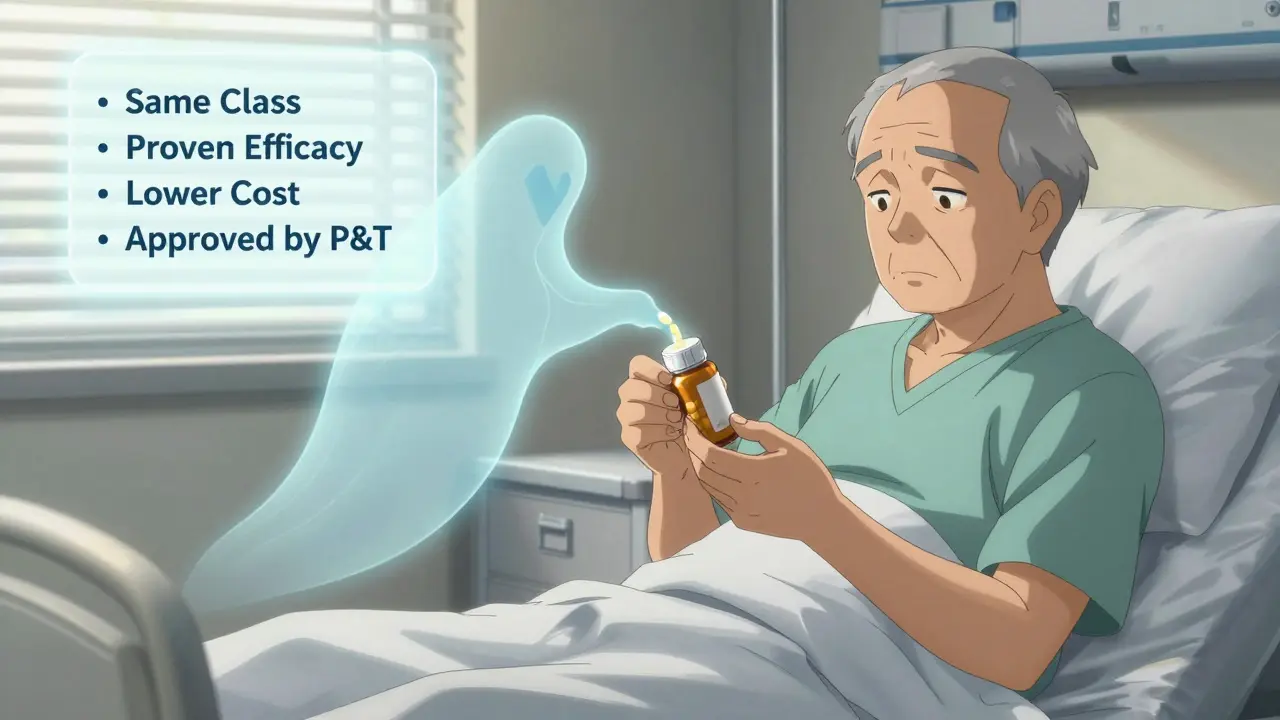
For example, if a doctor prescribes a brand-name statin like Crestor (rosuvastatin), but the facility’s formulary lists simvastatin as a preferred alternative with proven effectiveness and lower price, a pharmacist can suggest the switch - only if the Pharmacy and Therapeutics (P&T) Committee has already approved it. The two drugs aren’t identical. They’re chemically different. But they do the same job. That’s therapeutic interchange.
This is not generic substitution. Generic substitution means swapping a brand-name drug for its exact chemical copy - like taking atorvastatin instead of Lipitor. Therapeutic interchange goes further: it’s picking a different drug altogether from the same class, based on clinical data, cost, and safety profiles. And it’s not something you’ll typically see in your local pharmacy without the prescriber’s prior approval.
Who Decides What Gets Swapped?
It’s not the pharmacist alone. It’s not the doctor alone. It’s a team.
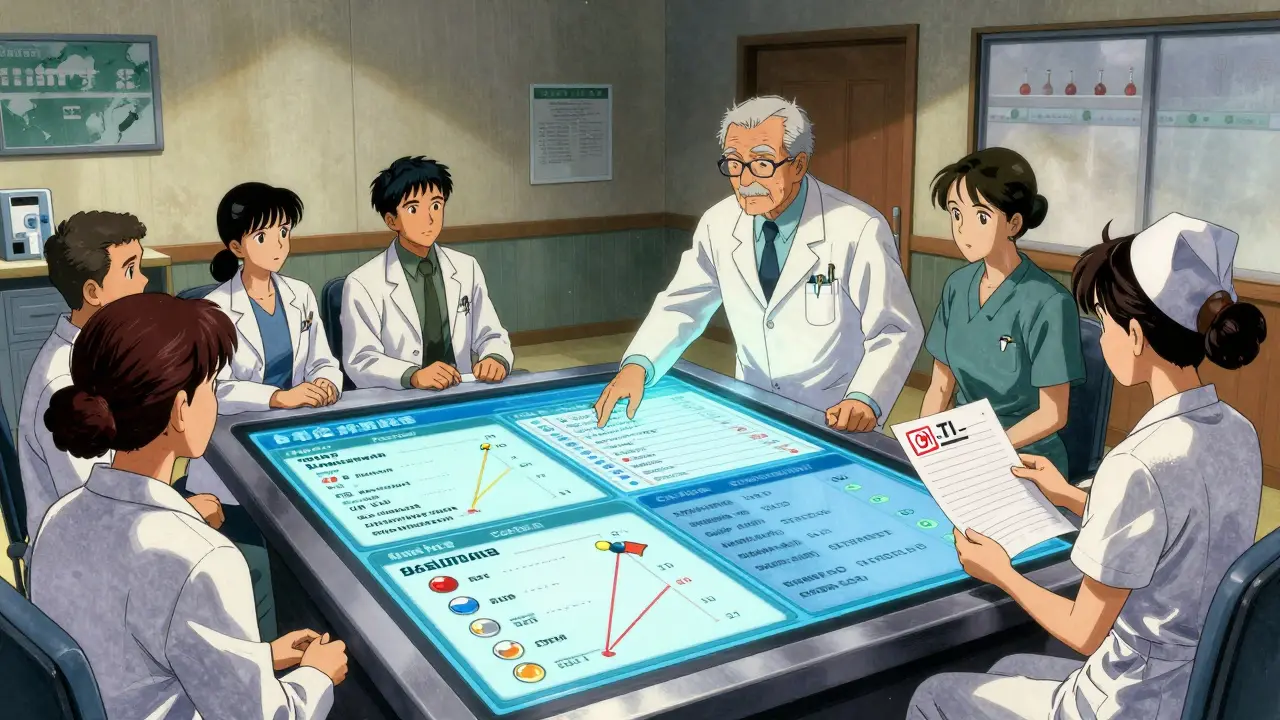
Every hospital or long-term care facility that uses therapeutic interchange has a Pharmacy and Therapeutics (P&T) Committee. This group includes pharmacists, physicians, nurses, and sometimes even patient advocates. They review the latest clinical studies, compare drug efficacy, monitor side effect profiles, and evaluate cost differences. Then they build a formulary - a list of approved medications the facility prefers to use.
Once that formulary is set, pharmacists can recommend substitutions within those approved categories. But even then, they don’t just swap drugs without telling anyone. In most cases, the prescriber must sign off - often through a “TI letter” (Therapeutic Interchange letter) - giving blanket permission to substitute specific drugs for certain patients. Once that’s done, every time that patient’s original drug is ordered, the pharmacy automatically dispenses the approved alternative.
This system saves time, reduces errors, and cuts costs. One skilled nursing facility in Ohio reported saving over $40,000 a month just by switching from expensive brand-name drugs to lower-cost alternatives within the same class. That’s money that can go toward better staffing, more therapy sessions, or improved patient meals.
Why Not Switch Between Different Classes?
Here’s where confusion creeps in. Some patients or even providers think, “If a beta-blocker didn’t work, why not just try a calcium channel blocker?” That’s not therapeutic interchange. That’s changing the treatment plan - and that’s the doctor’s call.
Therapeutic interchange only applies when two drugs are expected to have substantially equivalent outcomes. You can’t swap a diuretic for an anticoagulant and call it therapeutic interchange. The risks, mechanisms, and side effects are too different. The American College of Clinical Pharmacy (ACCP) is very clear: therapeutic interchange must occur within the same therapeutic class. Anything else is a new prescription, not a substitution.
Imagine a patient on metformin for type 2 diabetes. If their blood sugar isn’t controlled, the doctor might add a sulfonylurea - that’s a change in therapy. But if the facility’s formulary prefers glipizide over glyburide because it’s cheaper and has fewer hypoglycemia risks, and both are sulfonylureas, then switching from glyburide to glipizide? That’s therapeutic interchange.
Where It Works - And Where It Doesn’t
Therapeutic interchange thrives in places with structured systems: hospitals, long-term care facilities, VA centers. These places have formularies, P&T committees, electronic records, and standardized protocols. They can track outcomes, monitor for adverse events, and adjust policies based on data.
But in community pharmacies? It’s rare. Why? Because most states require pharmacists to contact the prescriber before making any substitution - even within the same class. Without a pre-signed TI letter, the pharmacist can’t just swap the drug. They have to call the doctor, explain the reason, wait for approval, and then wait for the new prescription to come in. That’s a workflow nightmare, especially when the pharmacy is busy.
That’s why therapeutic interchange is mostly invisible to the average patient. You might notice your pill looks different, or the name on the bottle changed - but you probably won’t know why. That’s by design. The goal is to make the switch seamless, safe, and cost-effective - without disrupting the patient’s routine or trust in their care.
The Real Benefits: Cost, Consistency, and Care
Let’s talk numbers. In 2018, over 80% of U.S. hospitals had formal therapeutic interchange programs. That’s not a trend - it’s standard practice. Why? Because drug prices keep climbing. A single medication can cost $300 a month in brand form, but $30 as a generic alternative within the same class. Multiply that by hundreds of patients, and you’re talking about millions saved per year.
But it’s not just about money. It’s about consistency. When a facility uses a standardized formulary, every patient gets the same evidence-based options. No more random prescribing. No more “I like this drug” or “My buddy took that one.” It’s clinical decision-making grounded in data.
Studies show therapeutic interchange can reduce side effects too. For example, switching from a long-acting benzodiazepine to a shorter-acting one in elderly patients can lower fall risk. Or replacing a drug with a high potential for drug interactions with a safer alternative in the same class. That’s not just cost savings - that’s better outcomes.
The Pitfalls and How to Avoid Them
Of course, it’s not perfect. The biggest risk? Making a substitution that isn’t right for the individual. A patient with kidney disease might not handle a certain drug in the same class as well as another. Or someone with a history of allergic reactions to one drug might react to a structurally similar one.
That’s why the ACCP guidelines stress two things: first, therapeutic interchange should only happen when the alternative drug is expected to provide a substantially similar benefit. Second, it must be based on an evidence-based formulary developed with input from multiple healthcare professionals.
Another issue? Prescriber resistance. Some doctors don’t trust the process. They think, “I prescribed this for a reason.” That’s valid - but it’s also why communication matters. Successful programs include clear documentation, education for prescribers, and mechanisms to reverse substitutions if needed.
And let’s not forget the patient. They should be told. Not just informed - educated. A simple conversation: “We’re switching your blood pressure pill to a different one that works the same way but costs less. You might notice the pill looks different, but your blood pressure goal stays the same.” That’s patient-centered care.
The Future: Smarter Formularies, Better Communication
Therapeutic interchange isn’t going away. With drug prices still rising and healthcare budgets under pressure, it’s a necessary tool. But the future isn’t about expanding it to different classes - that’s a dangerous misunderstanding. The future is about making it smarter.
More facilities are using clinical decision support tools that flag when a substitution might not be safe for a specific patient. Others are integrating patient-reported outcomes into their formulary reviews. And some are building AI-driven models that predict which patients are most likely to benefit from a switch based on their history, lab values, and comorbidities.
The goal remains the same: better care at lower cost. But now, it’s being done with more precision, more transparency, and more respect for the individual.
Therapeutic interchange isn’t about cutting corners. It’s about making smarter choices - with science, with teamwork, and with the patient’s best interest at the center.
Is therapeutic interchange the same as generic substitution?
No. Generic substitution means replacing a brand-name drug with its exact chemical copy - like switching from Lipitor to atorvastatin. Therapeutic interchange is swapping one drug for a different one within the same class - like switching from lisinopril to losartan. Both are cost-saving strategies, but therapeutic interchange involves drugs with different chemical structures that are clinically comparable, not identical.
Can a pharmacist make a therapeutic interchange without the doctor’s approval?
In most cases, no. In institutional settings like hospitals or nursing homes, pharmacists can make substitutions only if the Pharmacy and Therapeutics Committee has pre-approved the change and the prescriber has signed a Therapeutic Interchange (TI) letter. In community pharmacies, pharmacists almost always need to contact the prescriber for approval before making any switch - even within the same class.
Why can’t I just switch from a beta-blocker to a calcium channel blocker and call it therapeutic interchange?
Because those are different drug classes with different mechanisms of action. Therapeutic interchange only applies within the same class - like switching from metoprolol to atenolol, both beta-blockers. Switching between classes is a change in treatment plan, not a substitution. It requires a new prescription and clinical evaluation, not just a formulary decision.
Does therapeutic interchange affect patient outcomes?
When done correctly, it can improve outcomes. Studies show that using lower-cost, equally effective drugs reduces financial barriers to adherence. It also helps standardize care, reducing prescribing variability. In skilled nursing facilities, therapeutic interchange has been linked to fewer hospital readmissions and lower rates of adverse drug events - especially when combined with proper monitoring and patient education.
Are there state laws that control therapeutic interchange?
Yes. Laws vary widely by state. Some states allow “global” therapeutic interchange - meaning a prescriber signs one form that applies to all patients. Others require individual authorization for each patient. Some states don’t permit it at all in community pharmacies. Pharmacists must know their state’s rules before making any substitution.
What Patients Should Know
If your medication changes - and you didn’t ask for it - don’t panic. Ask: “Is this a therapeutic interchange?” Then ask: “Is it safe for me?” and “Will it work the same way?”
Most of the time, the answer is yes. But you have a right to know. And if you’re concerned, speak up. Your care team is there to help you understand - not just to save money, but to keep you healthy.




Retha Dungga
December 31, 2025 AT 19:37Jenny Salmingo
January 2, 2026 AT 14:20Aaron Bales
January 3, 2026 AT 10:44Pharmacists aren’t making wild swaps. They’re following protocols approved by teams of doctors and pharmacists.
If you don’t trust it, ask for the P&T committee’s guidelines. They’re public.
Lawver Stanton
January 3, 2026 AT 16:13Doctors used to pick meds based on what worked for the person. Now? It’s ‘what’s cheapest on the formulary.’
I’ve seen people switch from a med that stabilized them for years to some ‘equivalent’ one and then end up in the ER because their body didn’t like the new pill.
And no, ‘clinical data’ doesn’t always capture individual biology.
My aunt took a switch like this and got dizzy for three months. No one told her it was coming. No consent. Just a new pill in the bottle.
So yeah, ‘smarter choices’ sounds nice. But when your body’s the lab rat, it feels more like a gamble.
And don’t get me started on how pharmacies don’t even tell patients. That’s not transparency. That’s gaslighting with a clipboard.
Sara Stinnett
January 4, 2026 AT 00:21You call it ‘evidence-based,’ but evidence is often funded by pharma companies who want their cheaper drug on the formulary.
And the P&T committees? Mostly pharmacists and administrators. Where’s the patient voice? Where’s the neurodivergent? The elderly? The chronically ill with complex regimens?
It’s not about ‘better outcomes.’ It’s about balancing spreadsheets while patients become variables.
And don’t even get me started on the ‘TI letter’ - a legal loophole that lets institutions override individualized care under the guise of ‘protocol.’
This isn’t innovation. It’s institutionalized neglect wrapped in PowerPoint slides.
linda permata sari
January 4, 2026 AT 09:35Brandon Boyd
January 5, 2026 AT 15:27Think about it - you’re getting the same result, less money spent, fewer people skipping meds because they can’t afford them.
And yeah, sometimes the switch isn’t perfect - but that’s why you have monitoring and feedback loops.
This isn’t about cutting corners. It’s about lifting up care for everyone.
Don’t fear the system. Help make it better by asking questions and pushing for transparency. You’ve got a voice.
Branden Temew
January 6, 2026 AT 09:20Next they’ll replace doctors with AI that just picks the cheapest drug that doesn’t immediately kill you.
‘Substantially equivalent’ my foot. My body isn’t a lab model. It’s a messy, unique, emotional, hormonal, sleep-deprived organism.
And yet here we are - treating humans like interchangeable parts in a cost-cutting algorithm.
Bravo. We’ve achieved healthcare efficiency. Now who’s gonna fix the soul of it?
Frank SSS
January 7, 2026 AT 18:25My blood pressure went haywire for two weeks. The pharmacy didn’t call. My doctor didn’t know until I showed up with my new bottle.
And now I’m stuck with a med that gives me dry mouth so bad I can’t sleep.
So yeah, ‘cost savings’ - great. But who pays for the collateral damage?
Not the hospital. Not the pharmacy. Me.
And now I’m paranoid every time I get a refill.
So congrats. You saved $30 a month. I lost 3 months of peace.
Paul Huppert
January 9, 2026 AT 14:33Good system when done right.
Hanna Spittel
January 9, 2026 AT 16:40Also… what if the ‘equivalent’ drug is just a repackaged version of something that failed in trials? 🤫 #PharmaShadowGame