
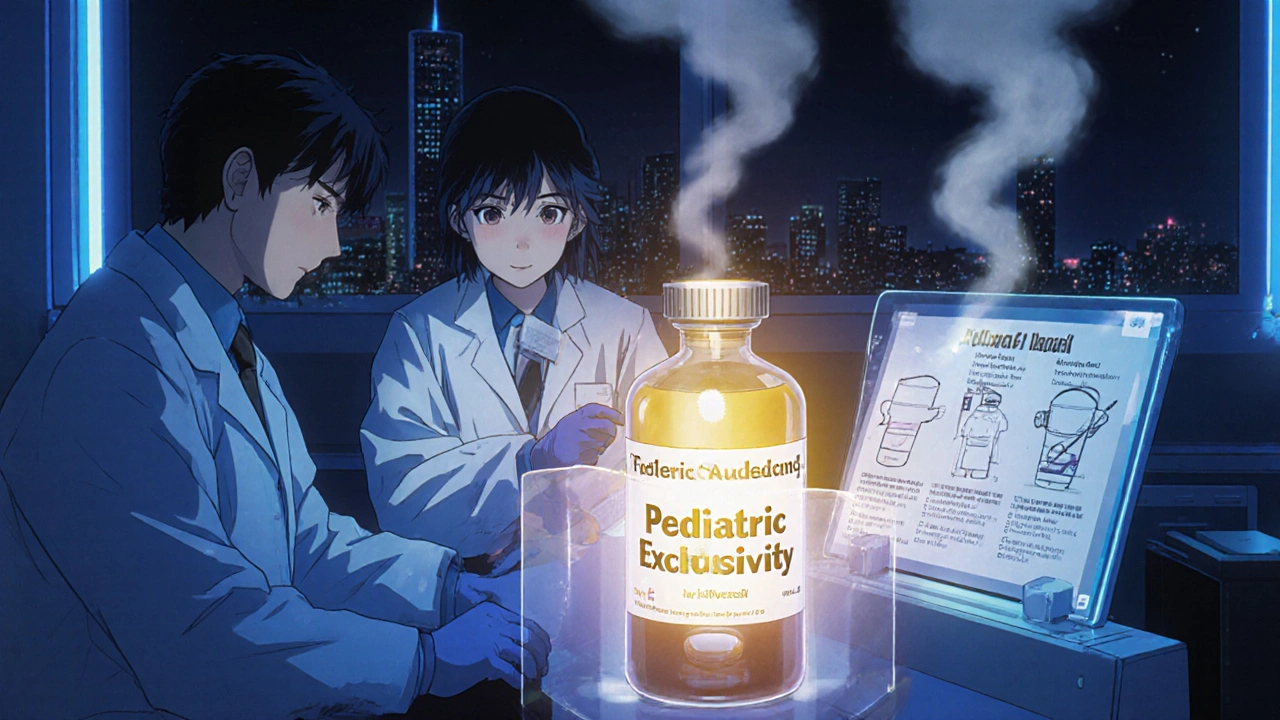
When a drug company finishes testing a new medicine for adults, they don’t just wait for patents to expire before thinking about the next step. They look at one powerful, often misunderstood tool: pediatric exclusivity. It’s not a patent extension in the traditional sense. It doesn’t make the patent last longer. But it does stop generic versions from hitting the market for six extra months - even after the patent has expired. And that’s worth hundreds of millions of dollars.
What pediatric exclusivity actually does
Pediatric exclusivity is a six-month reward given by the FDA to drugmakers who study their medicines in children. It’s not a bonus for being nice. It’s a legal tool built into U.S. drug law under Section 505A of the Federal Food, Drug, and Cosmetic Act. The goal? Get better data on how drugs work in kids. For decades, most medicines were only tested in adults. Doctors had to guess doses for children. Sometimes with dangerous results.
The FDA doesn’t just ask companies to do these studies. They issue a Written Request - a formal document listing exactly what studies are needed. The company must respond fairly. That means conducting the studies, submitting the results, and proving they followed the FDA’s instructions. If they do, the FDA grants six months of exclusivity.
Here’s the key: this exclusivity doesn’t extend the patent. It extends the FDA’s own rules. It blocks any company from filing an Abbreviated New Drug Application (ANDA) - the shortcut generic drug application - for six months. Even if the patent has already run out.
How it works when patents expire
This is where things get tricky. Many people assume that once a patent expires, generics can jump in. Not always. If a drug has pediatric exclusivity, the FDA can’t approve any generic version until that six-month clock runs out - even if there’s no patent left.
For example, imagine a drug with a patent that expired in January 2025. The company completed pediatric studies in March 2024 and got exclusivity. That exclusivity runs from March 2025 to September 2025. Even though the patent is gone, no generic can get final approval until September. The FDA treats the exclusivity like a wall. It doesn’t care about patents anymore. It only cares about the exclusivity period.
This is called a “Paragraph II” certification in the generic filing world. Normally, if a patent is expired, a generic applicant says “I’m not infringing - the patent’s dead.” But pediatric exclusivity overrides that. The FDA will reject the application anyway. Only after the six months pass can they approve it.
It applies to everything - not just one form
One of the most powerful parts of pediatric exclusivity is how broad it is. If a company studies a drug in children and gets exclusivity, it applies to all forms of that drug with the same active ingredient.
Let’s say a company makes an oral tablet, a liquid suspension, and a topical cream - all with the same active ingredient. They do one pediatric study on the tablet. If approved, the six-month exclusivity kicks in for all three products. Even if the liquid and cream were never studied in kids. The FDA considers them part of the same “active moiety.”
This makes pediatric exclusivity a huge strategic tool. A company might only need to study one form to protect its entire product line. That’s why big pharma companies prioritize these studies - even if they’re expensive. The return is massive.
It stacks with other exclusivities
Pediatric exclusivity doesn’t replace other types of protection. It adds on top of them. If a drug has five-year new chemical entity (NCE) exclusivity, or three-year exclusivity for new clinical studies, or orphan drug exclusivity - pediatric exclusivity extends all of them.
But there’s a catch: the underlying exclusivity must have at least nine months left when pediatric exclusivity is granted. If the original exclusivity is about to expire in three months, the FDA won’t add six more. The law says no. But if there’s a year left, the FDA extends it by six months. So a drug with five years of NCE exclusivity could end up with five-and-a-half years of protection.
This stacking effect is why pediatric exclusivity is called “ironclad” by legal experts. It’s not just a delay. It’s a multiplier. It turns a small window of protection into a much bigger one.
What it doesn’t cover
Pediatric exclusivity only applies to small-molecule drugs - the kind made by chemical synthesis. It does not apply to biologics. Biologics - like insulin, monoclonal antibodies, or vaccines - are made from living cells. They fall under a different law (the BPCIA), and there’s no pediatric exclusivity provision for them. The FDA explicitly says this in its guidance documents.
Also, if a drug has no patent or exclusivity left - and the company is just adding a new pediatric indication - they can still get pediatric exclusivity. But only if the new indication requires new clinical studies. The FDA won’t give it just because a company wants to market an old drug to kids. There has to be new data.

How generics can still get through
It’s not impossible for generics to enter during pediatric exclusivity. But the path is narrow.
First, the brand company can waive the exclusivity. Rare, but it happens - sometimes as part of a settlement. Second, a generic company can go to court and prove the patent underlying the exclusivity is invalid, not infringed, or unenforceable. If they win, the FDA must approve their application. Third, if the brand company doesn’t sue the generic within 45 days of being notified of a patent challenge, the exclusivity protection vanishes.
One famous case involved Apotex. The FDA allowed their generic to enter the market after Apotex won a patent lawsuit. The courts agreed: Congress didn’t intend for pediatric exclusivity to block generics that had legally beaten the patent.
Why it matters to patients and prices
Pediatric exclusivity keeps prices high for six months longer than they would be otherwise. That’s bad for consumers. But it also means more drugs have proper dosing instructions for children. Before this law, many pediatric prescriptions were off-label - meaning doctors guessed the dose. Now, labels say exactly how much to give a 5-year-old or a newborn.
Studies show that pediatric labeling has improved dramatically since 1997, when the first exclusivity rules started. Fewer kids are being overdosed. Fewer are being underdosed. The FDA estimates that over 1,000 drugs now have pediatric labeling because of this system.
It’s a trade-off. More safety for kids - but delayed access to cheaper generics. The law tries to balance both. It doesn’t force companies to study kids. It just gives them a big financial reason to do it.
The real value
A blockbuster drug with $2 billion in annual sales loses $100 million in revenue for every month of exclusivity lost. Six months of pediatric exclusivity can be worth $600 million - sometimes more. That’s why companies spend millions on pediatric studies. It’s not charity. It’s business.
And it works. Since 1997, over 500 pediatric exclusivity periods have been granted. Most go to drugs that already have patents. But some go to older drugs that were never studied in kids. That’s the hidden win: even drugs that are decades old can get new life - and better labeling - because of this rule.
Pediatric exclusivity isn’t about patents. It’s about control. It’s about giving the FDA a tool to make sure kids aren’t treated like small adults. And it’s about giving companies a reason to care. The system isn’t perfect. But it’s changed how medicine is made for children - and that matters more than any patent ever could.

Mindy Bilotta
November 30, 2025 AT 11:56so like... if a drug company does one kid study on a tablet, they get 6 months extra on EVERY form? like the cream and the liquid too? that’s wild. kinda feels like a loophole, but hey, at least kids aren’t getting random doses anymore.
Paul Corcoran
November 30, 2025 AT 20:16love how this system actually works. it’s not perfect, but it’s one of the few times pharma has to do something good for kids and gets rewarded for it. no more guessing doses for toddlers-thank god. i’ve seen what happens when you wing it with pediatric meds. scary stuff.
Colin Mitchell
December 2, 2025 AT 16:14my cousin’s kid was on a med that had zero pediatric data back in 2018. doctor just said ‘half a pill’ and crossed fingers. now? labels say ‘for ages 2–5: 2.5mg’. it’s a small thing, but it saves lives. this exclusivity thing? totally worth it.
Stacy Natanielle
December 4, 2025 AT 02:14Let’s be real: this is just Big Pharma’s way of extending monopolies under the guise of ‘child safety.’ 🤡 They don’t care about kids-they care about $600M. And don’t get me started on how they game the system by studying the easiest formulation only. #PharmaFraud
kelly mckeown
December 5, 2025 AT 10:20i never realized how much this affected everyday meds. i just thought generics came out after patents expired. wow. it’s kinda sad that we need to pay more so kids get safe doses… but also… grateful? 🥺
Tom Costello
December 7, 2025 AT 06:19Interesting how the FDA uses exclusivity as a regulatory lever rather than a patent tool. It’s smart-keeps the patent system clean while still incentivizing pediatric research. And the fact it applies to all formulations? That’s actually efficient. Not perfect, but functional.
dylan dowsett
December 9, 2025 AT 01:10Wait-so they’re literally rewarding companies for doing the bare minimum? And then blocking generics for six months? That’s not ‘helping kids’-that’s corporate greed dressed up as public health. Someone’s making millions off children’s safety. It’s disgusting.
Susan Haboustak
December 11, 2025 AT 00:04This system is a fraud. The studies are often superficial. Companies cherry-pick easy populations. The FDA approves them too quickly. And then? They get six months of monopoly profit. Meanwhile, parents still can’t afford the drug. This isn’t progress-it’s exploitation.
Chad Kennedy
December 12, 2025 AT 16:01so… this is just a delay tactic? like, they do a tiny study, get paid in time, and everyone waits? why not just pay them cash instead? this feels like a tax on sick kids.
Siddharth Notani
December 13, 2025 AT 09:33Actually, this is a rare example of regulatory incentive working. In India, pediatric data is often ignored. Here, even old drugs get updated. That’s progress. 🙌
Cyndy Gregoria
December 14, 2025 AT 06:29if this means fewer kids get hurt because a doctor guessed a dose… then yes, let’s keep it. i’d rather pay a little more for a while than risk my kid getting poisoned by a wrong pill. this isn’t about money-it’s about safety.
Akash Sharma
December 15, 2025 AT 03:25It's fascinating how the legal framework around pediatric exclusivity operates as a kind of regulatory extension rather than a patent modification, and the fact that it applies across all formulations under the same active moiety suggests a deeply interconnected pharmacological classification system that prioritizes therapeutic equivalence over formulation differences-this is actually quite sophisticated from a regulatory science perspective, and it highlights how the FDA has developed nuanced tools to balance innovation incentives with public health outcomes, even if the financial implications are substantial for manufacturers.
Justin Hampton
December 16, 2025 AT 17:51Yeah, sure. ‘Helping kids.’ But the same companies that do this also jack up prices on life-saving drugs and lobby to kill price caps. Don’t fool yourself. This isn’t altruism. It’s a tax on desperation.
Paul Corcoran
December 17, 2025 AT 21:02@5507 I get your anger, but the alternative is kids getting dosed like tiny adults. We need this. The system’s flawed, but scrapping it would hurt more than help.