
Imagine you just took a routine antibiotic or received a dose of contrast dye for a scan. Within minutes, your throat feels like it’s closing up, your breathing becomes noisy and difficult, and your vision starts to blur. This isn’t just a mild rash; this is medication-induced anaphylaxis, defined by the Resuscitation Council UK as a severe, life-threatening systemic allergic reaction characterized by sudden onset and rapid progression of airway, breathing, and circulation problems. It happens fast, and seconds count. In hospital settings alone, medications trigger about 20-30% of all anaphylaxis cases. The difference between walking out of the ER and ending up in intensive care often comes down to one thing: how quickly the right emergency response steps are taken.
You don’t need to be a doctor to recognize the danger signs. You do need to know exactly what to do when they appear. Here is the practical, evidence-based guide to surviving a drug allergy attack, based on the latest guidelines from major medical bodies including the Resuscitation Council UK and the American Academy of Allergy, Asthma & Immunology (AAAAI).
Recognizing the Silent Killer: Symptoms Beyond the Rash
We often think of allergies as hives and itching. While skin changes are common, relying on them can be deadly. According to data published in the Journal of Emergency Medicine, skin and mucosal changes are absent in 10-20% of anaphylaxis cases. If you wait for a rash, you might miss the window to save a life.
Focus on the ABCs: Airway, Breathing, and Circulation. The Australian Society of Clinical Immunology and Allergy (ASCIA) reports that difficult or noisy breathing occurs in 89% of cases. Other critical red flags include:
- Swelling of the tongue: Reported in 76% of cases.
- Tightness in the throat: Occurs in 82% of cases.
- Wheeze or persistent cough: Seen in 68% of patients.
- Voice changes: Difficulty talking or a hoarse voice affects 57% of sufferers.
- Circulatory collapse: Persistent dizziness, fainting, or collapse happens in 49% of cases. In children, look for a pale appearance, which is present in 33% of incidents.
If someone has two or more of these symptoms after taking a medication, assume anaphylaxis until proven otherwise. Do not wait for confirmation.
The Golden Rule: Position Matters More Than You Think
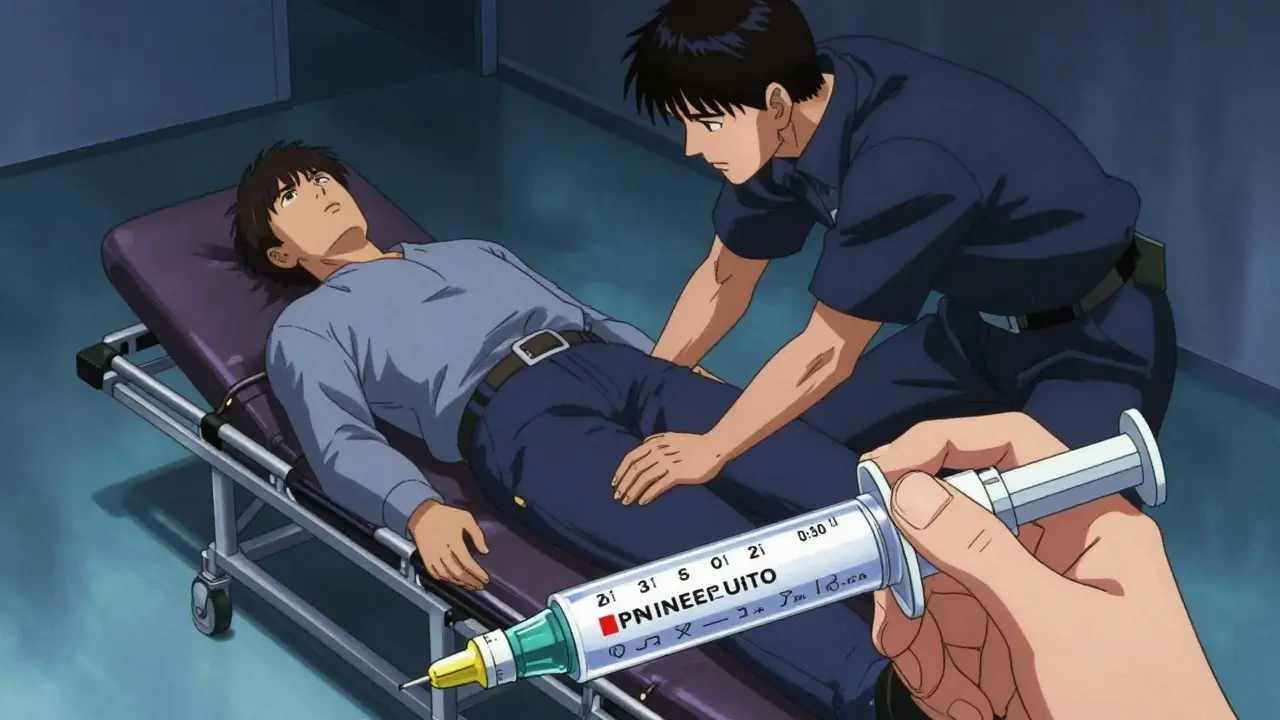
Before you reach for any medication, you must position the patient correctly. This step is frequently overlooked but is critical for survival. The Resuscitation Council UK’s May 2021 guidelines mandate that the patient must be laid flat immediately. Why? Because posture changes from lying down to standing are directly associated with cardiovascular collapse and death in 15-20% of cases.
When blood vessels dilate during an allergic reaction, blood pools in the legs. If the person stands up, gravity pulls that blood away from the heart and brain, causing sudden shock. Keep them horizontal. However, there are specific exceptions based on their condition:
- Unconscious patients: Place them in the recovery position (on their side) to keep the airway clear.
- Pregnant women: Lie them on their left side to prevent pressure on major blood vessels.
- Severe breathing difficulty: If laying flat makes breathing worse, allow them to sit up with legs outstretched. This helps expand the chest cavity.
- Young children: Hold them flat rather than upright to maintain blood flow to vital organs.
A simulation study by ASCIA involving 500 participants found that 55% of lay rescuers incorrectly allowed patients to stand during reactions. Avoid this fatal error. Lay them down.
Epinephrine: The Only Drug That Saves Lives
This is the most important part of the protocol. Antihistamines like diphenhydramine (Benadryl) treat skin symptoms but are completely ineffective for airway, breathing, or circulation problems. Corticosteroids like hydrocortisone take hours to work and are no longer recommended for routine initial treatment. The only medication that reverses the life-threatening mechanics of anaphylaxis is epinephrine (also known as adrenaline).
The Cleveland Clinic’s 2023 guidance emphasizes that epinephrine must be administered within 5 minutes of symptom recognition. Dr. Robert Wood of Johns Hopkins University notes that 70% of fatal anaphylaxis cases involve delayed or absent epinephrine administration. Hesitation kills.
Here is how to administer it correctly using an auto-injector device such as an EpiPen, Auvi-Q, or Adrenaclick:
- Identify the dose: Use 0.15 mg for children weighing 15-30 kg. Use 0.3 mg for adults and children over 30 kg.
- Inject into the thigh: Aim for the anterolateral (outer) mid-thigh. You can inject through clothing if necessary. Do not inject into the buttocks, arm, or subcutaneous fat.
- Hold firm: Press the injector against the thigh and hold it in place for the full 10 seconds. A Red Cross evaluation found that 37% of people fail to hold the device long enough, leading to incomplete dosing.
- Massage the area: After removing the needle, massage the injection site for 10 seconds to help absorption.
Epinephrine works within 1-5 minutes to constrict blood vessels, open airways, and support heart function. However, its effect lasts only 10-20 minutes. If symptoms persist after 5 minutes, administer a second dose. Some protocols suggest doses every 10 minutes if symptoms continue, but always call emergency services first.
Calling for Help and Hospital Observation
Once epinephrine is given, call 911 (or your local emergency number) immediately. Even if the person feels better, they are not safe yet. Medication-induced anaphylaxis carries a 20% risk of biphasic reactions-where symptoms return 1 to 72 hours later without re-exposure to the drug.
The Food Allergy Research & Education (FARE) and other organizations specify that hospital transfer for a minimum of 4-hour observation is mandatory. For high-risk patients with medication-induced reactions, recent draft guidelines from 2024 suggest extending this to 6-8 hours due to a 25% higher risk of biphasic responses compared to food-induced cases.
In the hospital, IV fluid resuscitation (1-2 liters of normal saline) is now considered an essential adjunct to epinephrine in cases of shock. The PARAMEDIC2 trial showed a 22% reduction in mortality when fluids were combined with timely epinephrine. If the patient is refractory-meaning ABC problems persist despite two IM epinephrine doses-they may require IV epinephrine infusions administered by specialists.
Common Barriers and How to Overcome Them
Why do delays happen? Fear. A 2021 survey of 1,200 nurses revealed that 42% admitted delaying epinephrine due to fear of legal repercussions or side effects like tachycardia (fast heart rate). But let’s look at the data: out of 35,000 documented epinephrine administrations for anaphylaxis between 2015-2020, only 0.03% resulted in significant adverse cardiac events. The risk of not giving it is far greater.
For patients carrying their own auto-injectors, confidence is low. A 2023 FAACT survey found that while 68% of patients with medication allergies carried injectors, only 41% felt confident using them. Technical errors are common:
- Improper technique: 23% of users inject incorrectly.
- Wrong location: 18% inject into subcutaneous fat instead of muscle.
- Hesitation: 29% report hesitating during actual reactions.
To combat this, practice with trainer devices regularly. Newer models like the Auvi-Q 4.0, approved by the FDA in May 2023, feature voice guidance that improved correct administration rates from 63% to 89% among untrained users in clinical trials.

Special Considerations for Medication Reactions
Not all drug reactions are the same. Antibiotics cause 45% of medication-related anaphylaxis deaths, followed by NSAIDs (25%) and neuromuscular blocking agents (15%). If the patient is taking beta-blockers (common in adults over 40), standard epinephrine doses may be less effective. Studies show these patients may require 2-3 times higher doses because beta-blockers block some of epinephrine’s effects. Inform paramedics immediately if the patient is on beta-blockers.
Recent research from the NIH is investigating dosing based on Body Mass Index (BMI) rather than weight alone. Early results show 18% more consistent therapeutic blood levels in obese patients (BMI >30) using this approach. Until guidelines update, stick to the standard weight-based dosing: 0.15 mg for under 30 kg, 0.3 mg for over 30 kg.
| Treatment | Effectiveness for Life-Threatening Symptoms | Onset Time | Role in Protocol |
|---|---|---|---|
| Epinephrine (IM) | High (Reverses airway/breathing/circulation issues) | 1-5 minutes | First-line, immediate action |
| Antihistamines (e.g., Benadryl) | Low (Only treats skin symptoms) | 20-60 minutes | Adjunct only, never first-line |
| Corticosteroids (e.g., Hydrocortisone) | Low (Takes hours to work) | 4-6 hours | Reserved for refractory cases |
| IV Fluids | High (Supports blood pressure in shock) | Immediate upon infusion | Essential adjunct in hospital setting |
Frequently Asked Questions
What is the first thing to do in a medication anaphylaxis emergency?
The first step is to recognize the symptoms (difficulty breathing, swelling, collapse) and immediately lay the patient flat to prevent cardiovascular collapse. Then, administer intramuscular epinephrine into the outer thigh within 5 minutes. Call emergency services simultaneously.
Can antihistamines like Benadryl stop anaphylaxis?
No. Antihistamines only treat skin symptoms like hives and itching. They do not reverse airway obstruction, breathing difficulties, or circulatory shock. Relying on them alone can be fatal. Epinephrine is the only effective first-line treatment.
How long should a patient stay in the hospital after a reaction?
Patients should be observed for a minimum of 4 hours. For medication-induced anaphylaxis, recent guidelines suggest 6-8 hours for high-risk patients due to a higher chance of biphasic reactions, where symptoms return hours later without further exposure.
What if the patient is wearing beta-blockers?
Beta-blockers can reduce the effectiveness of epinephrine. Patients on these medications may require higher doses (2-3 times the standard amount) or additional treatments like glucagon. Always inform paramedics if the patient takes beta-blockers.
Is it safe to give epinephrine if I’m not sure it’s anaphylaxis?
Yes. The ASCIA First Aid Plan advises 'IF IN DOUBT GIVE ADRENALINE DEVICE.' Data shows that significant adverse events from epinephrine are extremely rare (0.03%), while delayed administration contributes to 70% of fatalities. It is safer to give it unnecessarily than to withhold it in a true emergency.