
When two drugs are supposed to do the same thing, how do you prove they work the same way in real patients? It’s not enough to test them on a handful of healthy volunteers. Real people have different weights, ages, kidney function, and other drugs in their systems. That’s where population pharmacokinetics comes in - a powerful method that uses real-world data from hundreds of patients to show whether two drug formulations deliver the same amount of medicine to the body, over time, across diverse populations.
What Is Population Pharmacokinetics (PopPK)?
Population pharmacokinetics, or PopPK, is not about studying one person in a lab with frequent blood draws. It’s about analyzing sparse, messy, real-life data from patients who are taking medication as part of normal care - maybe only two or three blood samples taken at random times during a hospital stay or clinic visit. This approach started gaining traction in the late 1970s, thanks to early work by researchers like Lewis Sheiner, who showed that you could extract meaningful patterns from imperfect data. Today, PopPK uses nonlinear mixed-effects modeling to separate what’s typical for the whole population from what’s unique to each individual. Think of it like averaging out a thousand different drug responses to find the core pattern - then seeing how factors like weight, age, or kidney function shift that pattern up or down.
Traditional bioequivalence studies require 24-48 healthy volunteers, each giving 8-12 blood samples over 24-48 hours. PopPK doesn’t need that. It uses data from 40 or more patients, each with just 2-4 samples. That’s a huge difference in cost, ethics, and practicality - especially when you’re studying drugs for babies, elderly patients, or people with liver or kidney disease. In those groups, you can’t ethically give multiple high-dose blood draws just to compare two pills. PopPK lets you answer the question without putting patients through unnecessary procedures.
How PopPK Proves Equivalence
Instead of just comparing average blood levels (like traditional studies do), PopPK looks at variability. It calculates two key numbers: between-subject variability (BSV) and residual unexplained variability (RUV). BSV tells you how much drug exposure differs from person to person - say, a 35% variation in how fast someone clears the drug. RUV captures noise from sampling errors or timing issues. Together, they create a realistic picture of how the drug behaves across a real population.
For equivalence, regulators like the FDA don’t just ask: “Is the average exposure the same?” They ask: “Is the range of exposure within acceptable limits for everyone?” For example, if one formulation gives 90% of patients exposure between 80-120% of the reference drug, and the other gives 75-130%, PopPK can show whether that wider spread matters clinically. If the narrow therapeutic index drug (like warfarin or digoxin) has a safety window of just 10%, even small shifts in exposure can mean toxicity or treatment failure. PopPK models can pinpoint those risks by linking covariates - like creatinine clearance or body weight - directly to drug clearance rates.
The FDA’s 2022 guidance made it official: PopPK data can replace some postmarketing studies. If your model shows that two formulations produce equivalent exposure across age, weight, and renal function subgroups - and the variability stays within 20% - you might not need another clinical trial. That’s not theoretical. Between 2017 and 2021, about 70% of new drug applications included PopPK analyses to support dosing recommendations. Companies like Pfizer and Merck have used it to cut development time by 25-40% by avoiding redundant trials.
PopPK vs. Traditional Bioequivalence
Traditional bioequivalence relies on crossover studies with tight controls: same person, same dose, same timing, same lab. The gold standard is a 90% confidence interval for AUC and Cmax between 80% and 125%. That works fine for healthy adults taking simple oral drugs. But it breaks down fast when you need to prove equivalence for:
- Neonates with underdeveloped livers
- Patients on dialysis
- People taking five other medications
- Biosimilars with complex structures
PopPK flips the script. It doesn’t assume everyone is the same. It assumes variability is the norm. Instead of forcing patients into a lab, it uses data from real clinical settings. A 2021 study from the American College of Clinical Pharmacology showed that PopPK successfully demonstrated equivalence in renal impairment patients where traditional studies would’ve required unethical dosing levels. Another case from a generics manufacturer used PopPK to prove bioequivalence for a pediatric formulation - something that would’ve taken years and dozens of ethical review board approvals under the old model.
But PopPK isn’t a magic bullet. It struggles with drugs that have extremely high variability - where within-subject differences are bigger than between-formulation differences. In those cases, replicate crossover designs still win. Also, PopPK needs high-quality data. If the blood samples are taken at inconsistent times, or if patient records are incomplete, the model can’t compensate. That’s why experts say: “Garbage in, garbage out.”

Tools and Requirements
Running a PopPK analysis isn’t something you do in Excel. It requires specialized software - and deep expertise. The industry standard is NONMEM is a nonlinear mixed-effects modeling software developed in the 1980s and still used in 85% of FDA-submitted PopPK analyses. Other tools like Monolix and Phoenix NLME are gaining ground, especially in Europe. But the real challenge isn’t the software - it’s the people. It takes 18-24 months of dedicated training for a pharmacokineticist to become proficient. You need to understand statistics, physiology, pharmacology, and regulatory expectations all at once.
Successful PopPK studies share three traits:
- They start early - ideally in Phase 1 trials, not after Phase 3 fails.
- They plan sampling carefully - not just randomly, but strategically to capture key time points (absorption, peak, elimination).
- They document everything - every assumption, every covariate tested, every model comparison.
According to an analysis of FDA Complete Response Letters from 2019-2021, 30% of PopPK submissions were rejected or delayed because of poor model documentation or overparameterization. That’s avoidable. The FDA’s 2022 guidance is 78 pages long - and it’s full of examples. The EMA and PMDA in Japan have similar guidelines. There’s no excuse for sloppy work.
Challenges and Controversies
Despite its power, PopPK still faces pushback. A 2019 FDA workshop highlighted that “lack of standardization in model-building approaches” makes it hard for reviewers to compare submissions. One company’s “best model” might look completely different from another’s, even if they reach the same conclusion. That’s why groups like the IQ Consortium are working toward consensus validation protocols by late 2025.
Another issue? Data quality. Many clinical trials weren’t designed with PopPK in mind. Blood samples were taken for safety checks, not modeling. Sampling times were recorded poorly. Dosing logs were incomplete. That’s why 65% of pharmacometricians surveyed by the International Society of Pharmacometrics said model validation is their biggest hurdle. You can’t fix bad data with better math.
And regulatory acceptance isn’t global. The FDA is open to PopPK-only equivalence claims. The EMA is cautious. Some committees still demand traditional studies. A senior pharmacometrician on Reddit noted in 2023: “We got FDA approval using PopPK for a renal impairment claim. EMA asked for a separate study.” That inconsistency creates headaches for global drug developers.
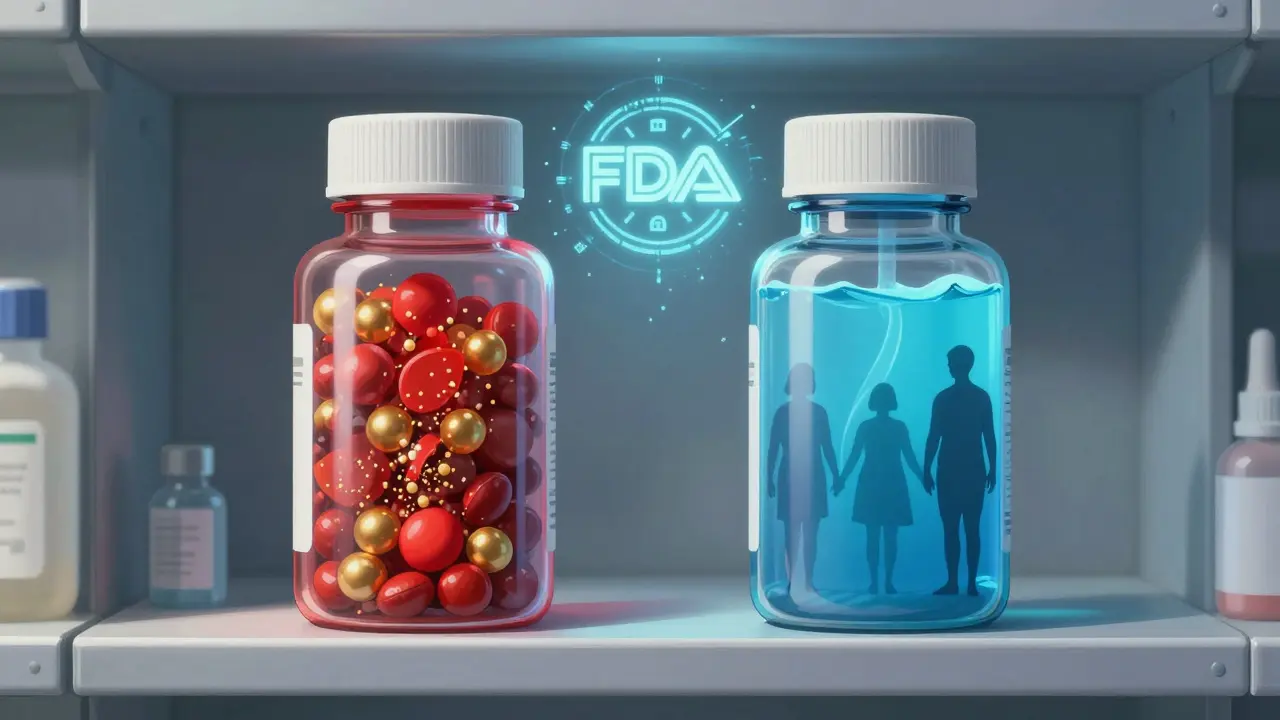
The Future of PopPK
The future is bright - and getting smarter. In January 2025, Nature published a study showing how machine learning can detect nonlinear interactions between covariates that traditional models miss. For example, a drug might behave differently in overweight patients with diabetes - a combination you’d never think to test unless the algorithm spotted the pattern itself. This isn’t science fiction; it’s already being used in biosimilar development.
The market is growing fast. The global pharmacometrics market, driven largely by PopPK, is projected to hit $1.27 billion by 2029. Nearly all top 25 pharma companies now have dedicated pharmacometrics teams - up from 65% in 2015. And it’s not just about generics anymore. Biosimilars, which are complex biologic drugs, rely almost entirely on PopPK to prove equivalence. Traditional methods can’t capture the subtle differences in how large molecules are absorbed or cleared.
The bottom line? PopPK isn’t replacing traditional bioequivalence - it’s expanding what’s possible. It lets us prove equivalence where we couldn’t before. It reduces trial burden. It personalizes dosing. And it’s becoming the new standard for complex drugs.
Can PopPK replace traditional bioequivalence studies entirely?
Not always. PopPK works best for drugs with narrow therapeutic windows or in populations where traditional studies are unethical or impractical - like children, elderly patients, or those with organ failure. For simple oral drugs in healthy adults, traditional crossover studies still provide the most precise estimates of within-subject variability. Regulators often require both: PopPK to support dosing across subgroups, and traditional studies to establish baseline equivalence.
How many patients do you need for a valid PopPK analysis?
The FDA recommends at least 40 participants, but the real number depends on how much variability you expect and how strong the covariate effects are. For example, if weight strongly affects drug clearance, you might need fewer patients because the signal is clear. If multiple factors interact weakly, you might need 100 or more. The key is statistical power - not just a number.
Why is NONMEM still the industry standard?
NONMEM has been around since the 1980s and is the only software with decades of regulatory acceptance. Every FDA reviewer knows how to interpret a NONMEM output. Newer tools like Monolix are user-friendly and faster, but regulators still demand compatibility with legacy submissions. That’s why 85% of FDA PopPK analyses still use NONMEM - even if companies use other tools internally for exploration.
Is PopPK used for biosimilars?
Yes - and it’s essential. Biosimilars are large, complex molecules that can’t be analyzed using traditional methods like dissolution testing or simple blood concentration comparisons. PopPK is the primary tool for showing that the biosimilar behaves the same way as the reference product across different patient subgroups. Over 60% of biosimilar applications submitted since 2020 included PopPK as the core equivalence argument.
What’s the biggest mistake companies make when using PopPK?
Waiting too late. Many teams try to add PopPK after Phase 3 data is collected - but if the blood sampling wasn’t planned for modeling (e.g., no samples at peak absorption or elimination), the data is useless. The best practice is to design PopPK into Phase 1 trials from day one. That’s when you can control sampling times, record covariates accurately, and collect enough information to build a robust model.
Final Thoughts
Population pharmacokinetics isn’t just a statistical trick. It’s a paradigm shift. It moves us from asking, “Do these drugs work the same in a lab?” to “Do they work the same in the real world?” With regulatory agencies now fully on board, and machine learning adding new layers of insight, PopPK is becoming the go-to method for proving equivalence in the most challenging cases. For patients, that means safer, more personalized dosing. For developers, it means faster, cheaper paths to market. And for regulators, it means smarter decisions based on real data - not idealized lab conditions.





Kathy Leslie
March 14, 2026 AT 10:46Amisha Patel
March 15, 2026 AT 04:12Elsa Rodriguez
March 16, 2026 AT 08:49Serena Petrie
March 17, 2026 AT 07:22Buddy Nataatmadja
March 18, 2026 AT 18:51mir yasir
March 20, 2026 AT 17:09Stephanie Paluch
March 22, 2026 AT 12:50tynece roberts
March 22, 2026 AT 20:24