FDALabel Search Optimizer
Find the Best Search Strategy
Enter a search term and we'll suggest where to look in FDA drug labels for the most accurate results. This tool helps you maximize your FDALabel database queries for safety information.
Optimal Search Strategy
Your search for "" should be run in the section of FDALabel.
We recommend using the MedDRA term for more accurate results.
Why this matters
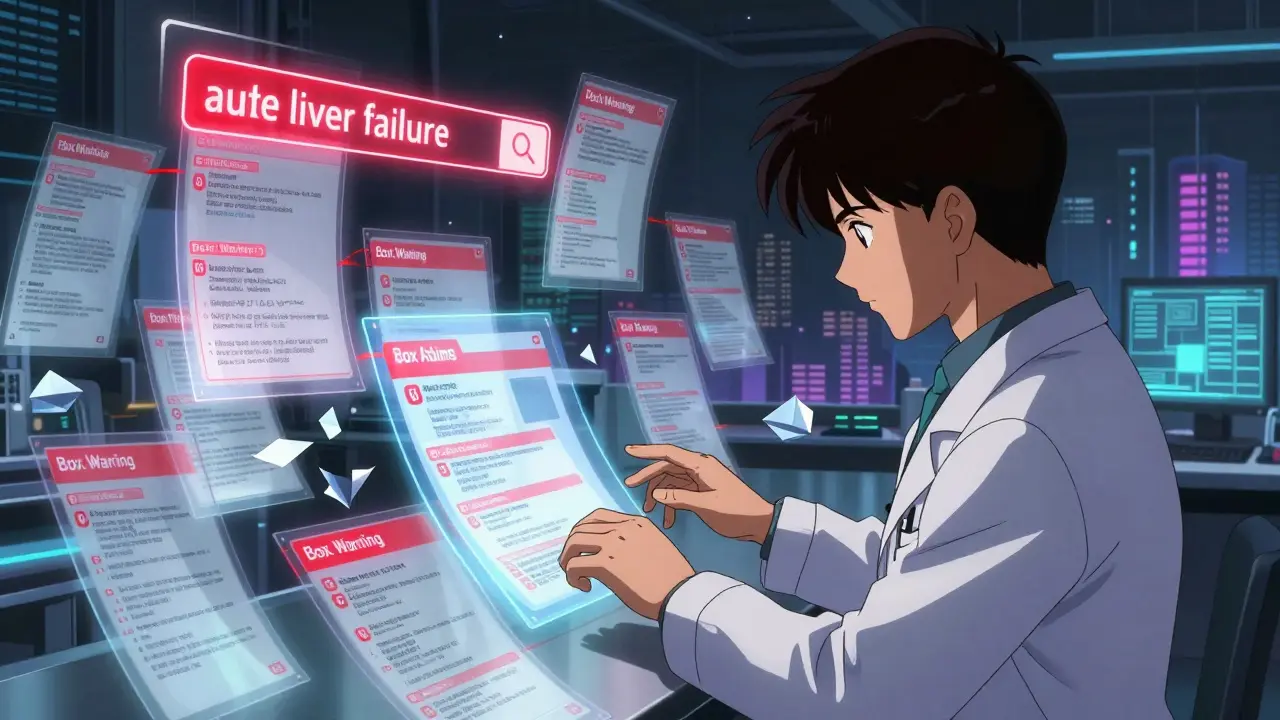
Searching specific sections like Boxed Warning or Adverse Reactions yields 3-5x more relevant results than full-text search. FDALabel returns 66+ matches when searching "acute liver failure" in Boxed Warning versus fewer than 10 in general search.
Every year, over 10,000 new drug labels are added to the FDA’s system. If you’re a pharmacist, researcher, or even a curious patient, finding the exact warning, interaction, or dosage detail buried in hundreds of pages of legal text shouldn’t feel like digging through a landfill. That’s where the FDALabel Database comes in - a free, official tool built by the FDA to let you search the full text of drug labels like a pro, without needing a law degree.
What Is the FDALabel Database?
The FDALabel Database is not a marketing site or a third-party aggregator. It’s the FDA’s own public search engine for Structured Product Labeling (SPL) documents - the official, legally required labels for every prescription, over-the-counter, biological, and animal drug approved in the U.S. As of July 2024, it holds over 149,000 active drug labels, updated twice a month directly from manufacturer submissions. Unlike Drugs@FDA, which shows approval dates and status, or DailyMed, which just displays labels in static PDFs, FDALabel lets you search inside those documents - word by word, section by section.Think of it like Google for drug safety info. You can find all drugs with a specific boxed warning, track how often a side effect appears across brands, or compare how different manufacturers describe the same risk. It’s used daily by pharmaceutical companies, clinical researchers, FDA regulators, and even journalists investigating drug safety trends.
Why FDALabel Beats Other Drug Label Tools
You might already know Drugs@FDA or DailyMed. But here’s the difference:- Drugs@FDA tells you when a drug was approved and if it has generic versions. It doesn’t let you search the actual label text.
- DailyMed shows you the full label as a PDF. You can read it, but you can’t search across 100+ labels at once.
- FDALabel lets you type a phrase like “acute liver failure” and instantly see 66 drug labels where that exact phrase appears in the Boxed Warning section - all in under 5 seconds.
It also supports searches using MedDRA - the standardized medical terminology system for adverse events. So instead of typing “dizziness,” you can search for the official MedDRA term “vertigo” and find every label that uses it. This matters because manufacturers use these precise terms in regulatory filings. If you’re doing pharmacovigilance or drug safety research, skipping MedDRA means missing half the data.
Commercial tools like Micromedex or Lexicomp offer summaries and clinical interpretations - but they’re paywalled, and they don’t show you the original FDA-approved language. FDALabel gives you the raw, unedited source. No interpretation. No filtering. Just the truth as submitted to the FDA.
How to Use FDALabel: Step-by-Step
You don’t need to download anything. Go to www.fda.gov/FDALabelTool or nctr-crs.fda.gov/fdalabel. Here’s how to get started:- Start with a basic search. Type a drug name, active ingredient, or condition like “metformin” or “diabetes.” Click Search. You’ll get a list of matching labels.
- Narrow by category. Use the filters on the left: Human Prescription, OTC, Animal, or Biological. If you’re looking for insulin, select “Human Prescription” to skip animal insulin labels.
- Search within sections. Click “Advanced Search” and choose a specific section: Boxed Warning, Adverse Reactions, Drug Interactions, or Dosage and Administration. This is where FDALabel shines. Searching “liver injury” in Adverse Reactions will return far more relevant results than a full-text search.
- Use pharmacologic class. If you’re researching all drugs in the “SGLT2 inhibitors” class, select it from the dropdown. You’ll get every drug in that category, even if they have different brand names.
- Save your search. Click “Create Permanent Link” after running a query. Copy that URL. You can email it to a colleague, bookmark it, or come back to it next week. The results won’t change unless the labels are updated.
Pro tip: If you’re looking for a specific side effect like “angioedema,” don’t just search the term. Try searching “angioedema” in the Adverse Reactions section and the Boxed Warning section. Some drugs only mention it in one place.
Exporting Data for Analysis
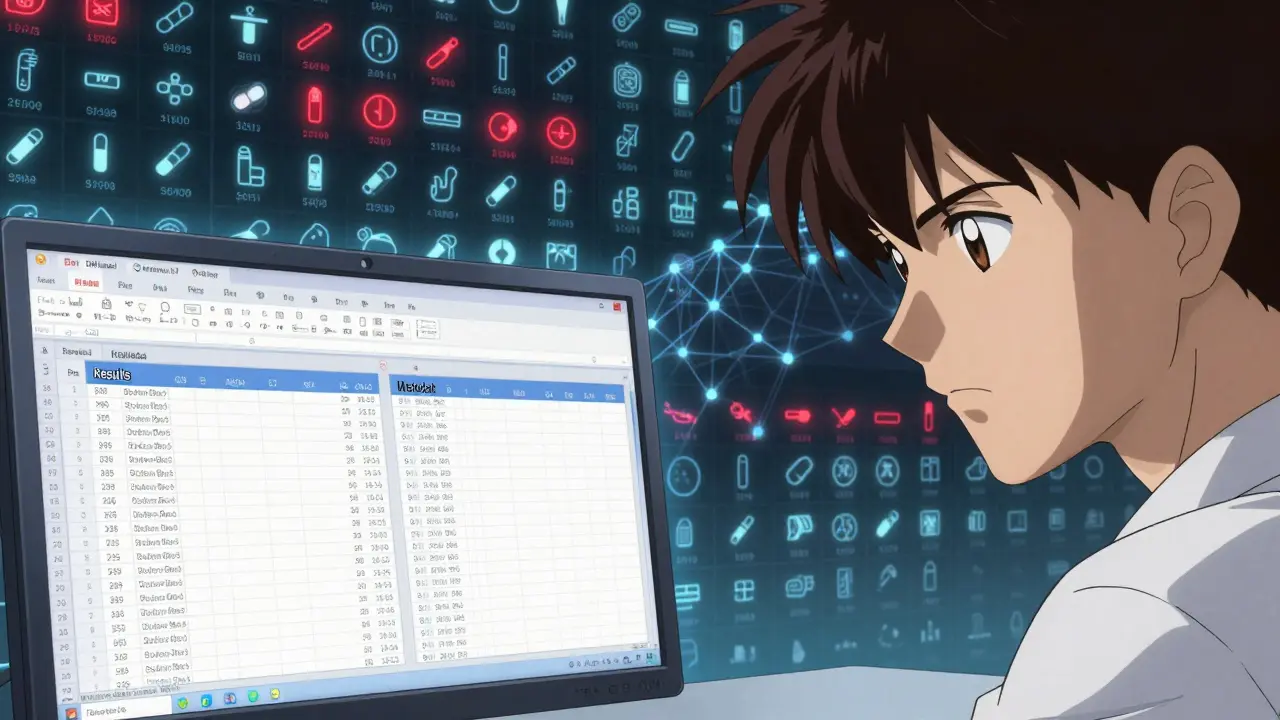
Version 2.9 (released July 2024) added Excel export - a game-changer for researchers. Before, you could only export results as CSV, which was messy for sorting and filtering. Now, when you run a search, click “Export Results.” You get two sheets:- Results - lists drug names, active ingredients, application types (NDA, ANDA), and links to each label.
- Metadata - contains the exact query you ran, the direct link to each result, and the date/time you exported it. This is critical for audits or research papers.
Researchers at the FDA have used this feature to build dashboards showing which drug classes have the most frequent adverse event reports. Pharmaceutical companies use it to spot gaps in their competitors’ labeling - like noticing that no other SGLT2 inhibitor mentions a specific kidney risk, while their own does.
Who Uses FDALabel - And Why
- Regulatory Affairs Teams at drug companies use it to verify their own labels against competitors’ before filing new applications.
- Pharmacovigilance Scientists search for rare adverse events across multiple drugs to detect emerging safety signals - like finding 12 different drugs linked to a specific type of pancreatitis.
- Academic Researchers use it in studies on drug safety disparities, labeling transparency, or how language changes over time. One 2023 study combined FDALabel with AI to automate adverse event detection - a project called AskFDALabel.
- Healthcare Providers use it to confirm dosing guidelines for off-label uses or check for interactions when prescribing to complex patients.
- Patient Advocates and Journalists use it to uncover hidden risks or inconsistencies in labeling that might not be in the news.
It’s not a tool for casual browsing. But if you need to know what the FDA actually approved - not what a website says it approved - this is your source.

Limitations and What It Doesn’t Do
FDALabel is powerful, but it’s not magic:- No pricing data. You won’t find cost, insurance coverage, or pharmacy availability.
- No clinical guidance. It won’t tell you whether a drug is better than another for your condition.
- No integration with EHRs. You can’t pull label info directly into your patient chart system.
- Terminology barrier. If you don’t know what MedDRA terms are or how NDA/ANDA classifications work, the filters can feel overwhelming.
It’s designed for people who already understand drug regulation. If you’re new, start with the FDA’s Quick Start Manual - it walks you through real search examples like finding all drugs with “acute liver failure” in the Boxed Warning.
Future of FDALabel
The tool is evolving. The FDA’s NCTR team is already testing AI-powered enhancements. The AskFDALabel project, which combines FDALabel with large language models, can now answer natural language questions like, “Which drugs carry the highest risk of kidney failure in elderly patients?” - and pull direct label excerpts as evidence.Future updates will likely include better visualization tools, more integration with the Orange Book and GSRS, and possibly even a mobile-friendly interface. But the core promise remains: direct, unfiltered access to the FDA’s official drug labeling data.
As drug complexity grows and safety monitoring becomes more data-driven, tools like FDALabel won’t just be useful - they’ll be essential.
Is FDALabel free to use?
Yes, FDALabel is completely free and publicly accessible. No registration, login, or subscription is required. It’s funded and maintained by the U.S. Food and Drug Administration as part of its transparency mission.
How often is FDALabel updated?
The database is updated twice a month, usually around the 1st and 15th of each month. These updates include newly approved drug labels, revised labels from manufacturers, and withdrawn products. The FDA announces major updates on its website and via a public mailing list.
Can I search for generic drugs in FDALabel?
Yes. FDALabel includes all approved drugs - brand-name, generic, and biosimilars. You can search by active ingredient (e.g., “amlodipine”) to find all generic versions, or by brand name (e.g., “Norvasc”). The system shows you the application type: NDA for brand drugs, ANDA for generics.
What’s the difference between SPL and FDALabel?
SPL (Structured Product Labeling) is the standardized electronic format that drug manufacturers submit to the FDA. FDALabel is the search tool that lets you query those SPL documents. Think of SPL as the raw data files, and FDALabel as the search engine that makes them usable.
Why can’t I find a drug I know is approved?
There are a few reasons. The drug might be new and not yet in the latest update cycle (updates happen twice monthly). It could be an animal drug or a compounded product - those aren’t always included. Or you might be searching a brand name that’s not in the label’s “Proprietary Name” field. Try searching the active ingredient instead.
Is FDALabel reliable for clinical decisions?
FDALabel provides the official FDA-approved labeling, which is the most authoritative source for prescribing information. However, it doesn’t offer clinical interpretation or guidance. Always consult with a healthcare provider before making treatment decisions. Use FDALabel to verify what’s in the label - not to replace medical advice.
How does FDALabel compare to DailyMed?
DailyMed displays individual drug labels as static PDFs or HTML pages. FDALabel lets you search across all 149,000+ labels at once, filter by section or drug class, and export results. DailyMed is great for reading one label. FDALabel is essential for comparing dozens - or finding patterns across hundreds.
Do I need to know MedDRA to use FDALabel?
Not for basic searches. You can type plain language like “headache” or “nausea.” But if you’re doing advanced research - especially on adverse events - knowing MedDRA terms (like “headache” vs. “head pain”) helps you find more accurate results. The FDA provides a MedDRA browser tool separately for reference.
Next Steps
If you’re new to FDALabel, start with one search: type the name of a drug you use regularly, then click “Advanced Search” and look for “Boxed Warning.” See what’s there. Then try searching for a side effect you’ve heard about - like “tendon rupture” - and see how many drugs list it. You’ll quickly see how much more you can learn when you stop reading one label at a time - and start searching them all together.For researchers: Bookmark the export feature. Save your queries. Share them with your team. The metadata sheet alone can save hours in documentation.
For everyone: FDALabel is the closest thing we have to a public, searchable record of what the FDA actually approved - down to the exact wording. Use it wisely. Use it often.



Christine Joy Chicano
January 7, 2026 AT 11:39Finally, a tool that cuts through the pharmaceutical BS. I’ve spent hours cross-referencing DailyMed and Drugs@FDA only to find half the info is outdated or buried in PDFs. FDALabel’s MedDRA search alone just saved me a week of manual filtering. The export feature? Pure gold for my pharmacovigilance reports. No more copy-pasting from screenshots.
And yes, I’ve used it to track how often ‘anaphylaxis’ appears in Boxed Warnings across SGLT2 inhibitors. Turns out, two brands quietly downplayed it in their labels until the FDA flagged them. This isn’t just useful-it’s necessary.
Stop using third-party aggregators. Go straight to the source. The FDA didn’t put this together for fun.
Also, the ‘Create Permanent Link’ feature? Genius. I’ve shared 14 queries with my team this month. No more ‘Hey, what was that drug with the liver warning again?’
Mina Murray
January 8, 2026 AT 23:07Don’t believe the hype. This ‘tool’ is just a glorified text scraper. The FDA doesn’t update it twice a month-they update it when they feel like it. I’ve seen labels sit unchanged for 47 days. And don’t get me started on MedDRA. They’re hiding adverse events under fancy terminology so Big Pharma doesn’t get sued. You think ‘vertigo’ is the real problem? Nah. It’s ‘loss of balance’-but they buried that in the ‘Other’ section.
Also, why is there no way to search by manufacturer? Because they don’t want you comparing how Johnson & Johnson labels their drugs vs. Pfizer. This isn’t transparency. It’s theater.
And don’t even mention ‘AI enhancements.’ They’re just training models to sanitize the data further. Wake up.
They’re not helping you. They’re protecting themselves.
Vince Nairn
January 10, 2026 AT 06:03Wow. Someone actually wrote a 2000-word love letter to a government database.
Let me guess-you printed this out and laminated it?
Look, I get it. You’re the guy who reads the instruction manual before opening the microwave. But for most of us, if the pill bottle says ‘take with food’ and doesn’t make us throw up, we’re good.
Still… I did search ‘tendon rupture’ and found 17 drugs. That’s kinda wild. So thanks, I guess. You weirdo.
Also, who the hell uses ‘MedDRA’ in casual conversation? That’s not a word. That’s a tax code.
Adam Gainski
January 12, 2026 AT 01:32Just wanted to add a quick tip for new users: if you’re looking for drug interactions, always search both ‘Drug Interactions’ AND ‘Warnings’ sections. Some labels mention interactions only in the warnings, especially with herbal supplements or alcohol.
I used this yesterday to confirm that a patient’s St. John’s Wort wasn’t listed in the interaction section of their SSRI-but it was buried in the ‘Clinical Pharmacology’ subsection. Saved a potential serotonin syndrome.
Also, the ‘Pharmacologic Class’ filter is underrated. Found 8 different anticoagulants with the same bleeding risk phrasing just by selecting ‘Factor Xa inhibitors.’
It’s not flashy, but it’s the most reliable source we’ve got. Use it like a scalpel, not a hammer.
Poppy Newman
January 13, 2026 AT 02:17Okay but can we talk about how the export feature is basically a superhero power? 🦸♀️ I just exported a list of all drugs with ‘QT prolongation’ in the Adverse Reactions section and dropped it straight into Excel. My boss cried. I didn’t. I just smiled and said ‘it’s called being efficient.’ 😌
Also, the permanent link thing? I sent my intern a query for ‘hepatotoxicity’ in antivirals and they found the answer in 90 seconds. No more ‘Can you Google that for me?’
Also also-why isn’t this on the App Store? I need this on my phone. I’m tired of pulling out my laptop during rounds. 🤖📱
Anastasia Novak
January 14, 2026 AT 13:22Let’s be real: this tool is just a PR stunt to make the FDA look ‘transparent’ while they quietly bury the real data in the SPL XML metadata that no one’s allowed to access.
Did you know that every label has a hidden ‘Risk Evaluation and Mitigation Strategy’ field that’s not searchable? It’s there. I’ve seen it. I’ve reverse-engineered the API. They don’t want you seeing how many drugs have ‘unquantifiable risk’ flagged internally.
And don’t get me started on the ‘Update Cycle.’ They only update when a lawsuit is pending. That’s not transparency. That’s damage control.
It’s like giving someone a flashlight in a cave and calling it ‘light access.’
Also, I’m pretty sure they’re using this to train AI to predict which adverse events to suppress next. Just a theory. But it’s a good one.
Kyle King
January 16, 2026 AT 10:44YOU’RE ALL BEING MANIPULATED.
FDALabel? It’s a honeypot. They let you search for ‘suicidal ideation’ so they can track who’s looking. Then they flag your insurance. Then they deny your prescription. I know a guy who got flagged after searching ‘lithium overdose’-his meds got pulled for ‘risk profile.’
They don’t care if you find the truth. They care if you’re looking for it.
And why is there no way to search by patent expiration? Because they don’t want you knowing which drugs are about to go generic. That’s the real agenda.
Wake up. This isn’t a tool. It’s a trap.
Also, I once found a label that said ‘may cause spontaneous combustion.’ It’s gone now. They scrubbed it. I have a screenshot. It’s real.
Kamlesh Chauhan
January 17, 2026 AT 14:43why is this even a thing
like i just want to know if my blood pressure med makes me sleepy
why do i need to know meddra or spl or whatever
the whole thing is just a waste of time
also who cares about export features
just tell me if i can drink coffee with my pills
that's all i need
why is everyone so obsessed with this
its like a library with no books just a sign that says 'books are here'
Jessie Ann Lambrecht
January 19, 2026 AT 06:45Look, I used to think this was overkill-until my mom had a bad reaction to a generic blood thinner and we couldn’t find the exact warning because the brand name label didn’t match the generic’s phrasing. I used FDALabel to search the active ingredient, filtered by ‘Adverse Reactions,’ and found the exact sentence buried in the generic’s label: ‘increased risk of hemorrhage in patients over 75.’
That one line changed her treatment plan. No doctor had caught it. No pharmacy app even mentioned it.
This isn’t just for researchers. It’s for people who love someone who takes meds. It’s for the ones who refuse to let corporate jargon hide the truth.
So yeah-use it. Bookmark it. Share it. Teach your grandma how to use it. Because if we don’t demand transparency, someone else will decide what we’re allowed to know.
And trust me-you don’t want that.