Anticholinergic Burden Calculator
How Anticholinergic Burden Works
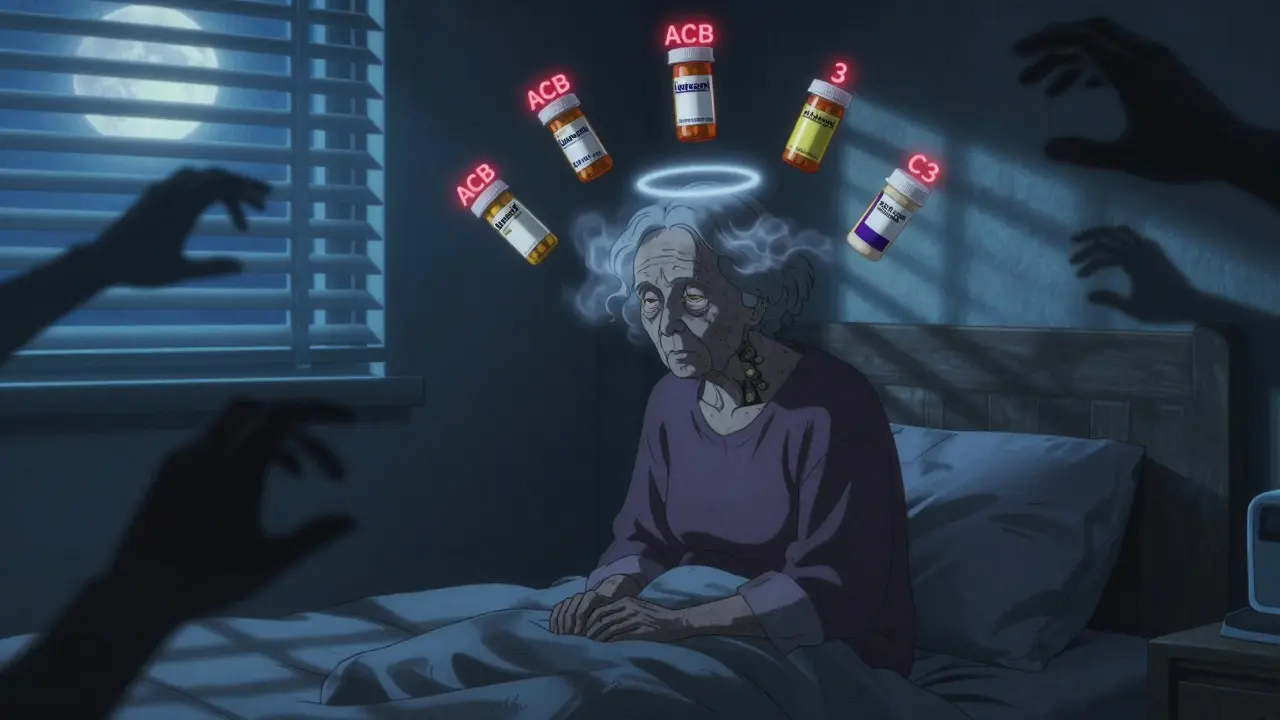
Anticholinergic drugs block acetylcholine, a brain chemical critical for memory and focus. When combined, their effects add up. The ACB Scale rates medications from 0-3. A total score of 3 or higher increases risk of dementia, falls, and confusion.
Add Your Medications
Your Selected Medications
Calculate Your Burden
Total ACB Score: 0
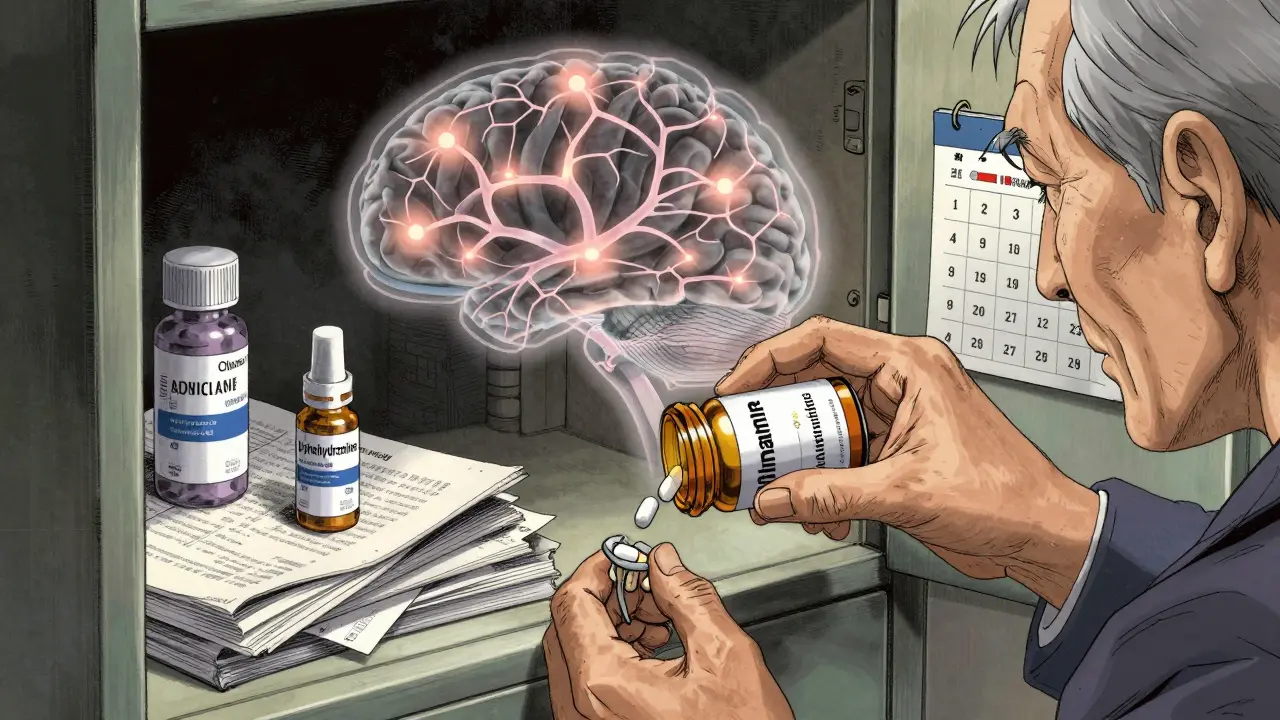
Every year, millions of older adults take over-the-counter antihistamines like diphenhydramine (Benadryl) or chlorpheniramine to help with allergies or sleep. Many don’t realize these common pills are not just mild sedatives-they’re powerful blockers of acetylcholine, a brain chemical critical for memory, focus, and muscle control. When combined with other medications, even ones prescribed by doctors, the effect adds up. This buildup is called cumulative anticholinergic burden, and it’s quietly increasing the risk of dementia, falls, confusion, and hospital stays in people over 65.
What Is Anticholinergic Burden, Really?
Anticholinergic drugs block acetylcholine, a neurotransmitter that helps your brain send signals to your body. Think of it like turning down the volume on your nervous system. When one drug does this, your body adjusts. But when you take three, four, or five of them-some prescribed, some bought at the pharmacy-the volume gets turned so low that your brain starts to misfire.
The Anti-Cholinergic Burden (ACB) Scale is a standardized tool developed in 2008 to measure how much anticholinergic activity a person is exposed to across all their medications. It rates each drug on a scale from 0 to 3:
- Score 0: No anticholinergic effect (e.g., loratadine, fexofenadine)
- Score 1: Mild effect (e.g., cetirizine, some diuretics)
- Score 2-3: Strong effect (e.g., diphenhydramine, amitriptyline, oxybutynin)
A total ACB score of 3 or higher is where the danger kicks in. People with this level of exposure are 33% more likely to be hospitalized in a year. For those taking strong anticholinergics for over three years, the risk of dementia jumps by 54%, according to a 2015 JAMA study tracking over 3,400 adults.
Why Antihistamines Are the Silent Culprit
Not all antihistamines are the same. Second-generation ones like loratadine (Claritin) and fexofenadine (Allegra) barely touch acetylcholine. Their ACB score is 0 or 1. But first-generation antihistamines-diphenhydramine (Benadryl), chlorpheniramine (Chlor-Trimeton), and doxylamine (Unisom)-are strong blockers. They’re cheap, easy to find, and often used nightly for sleep.
Here’s the problem: people don’t think of these as "medications" the way they think of blood pressure pills. A 70-year-old might take:
- Diphenhydramine 25 mg at night for sleep (ACB score 3)
- Oxybutynin 5 mg for overactive bladder (ACB score 3)
- Amitriptyline 25 mg for nerve pain (ACB score 3)
Add those up: ACB score of 9. That’s not a fluke. That’s a recipe for confusion, urinary retention, falls, and memory loss. And it’s not rare. In fact, 50% of older adults take five or more medications daily. Many of them include at least one strong anticholinergic.
What Happens When You Combine Them?
It’s not just about how many drugs you take-it’s which ones. The real danger comes from stacking anticholinergic effects. Take one drug with a score of 2 and another with a score of 1? That’s 3. You’ve crossed the danger line.
Common combinations that sneak up on people:
- Antihistamine + bladder medicine: Oxybutynin or tolterodine (for urinary leaks) + diphenhydramine (for allergies) = ACB score 6
- Antihistamine + antidepressant: Amitriptyline or nortriptyline (for depression or pain) + doxylamine (for sleep) = ACB score 6
- Antihistamine + Parkinson’s drug: Benztropine (for tremors) + chlorpheniramine (for colds) = ACB score 5
And these aren’t just theoretical. A 2021 case study from NPS MedicineWise followed a 72-year-old woman with an ACB score of 5. She was forgetful, fell often, and was misdiagnosed with early dementia. After switching diphenhydramine to cetirizine and replacing amitriptyline with a non-anticholinergic pain reliever, her memory improved, and falls dropped by 75% in six months.
The Hidden Sources: OTC Drugs You Never Think About
Here’s the blind spot: 70% of strong anticholinergic drugs are sold over the counter. No prescription needed. No warning label that says, "This may cause dementia." That’s why so many people don’t connect their memory lapses to their nightly allergy pill.
Common OTC products with high ACB scores:
- Benadryl (diphenhydramine)
- Unisom (doxylamine)
- NyQuil (diphenhydramine)
- Excedrin PM (diphenhydramine)
- Some cold and flu combos (chlorpheniramine)
These aren’t "harmless" sleep aids. They’re potent brain suppressors. And they’re taken for years-not just a few nights. A 2023 study showed that people over 65 who took diphenhydramine nightly for more than 3 years had a 60% higher risk of developing dementia than those who didn’t.
How to Check Your Burden
You don’t need a lab test. You just need to look at your pill bottle list. Here’s how to do it:
- Write down every medication you take, including vitamins, supplements, and OTC drugs.
- Check each one against the ACB Scale. You can find free online tools from the IU Center for Aging Research or NPS MedicineWise.
- Add up the scores. If the total is 3 or more, talk to your doctor.
- Ask: "Is this drug necessary? Is there a non-anticholinergic alternative?"
For example:
- Instead of diphenhydramine for sleep: Try melatonin (0.5-3 mg) or cognitive behavioral therapy for insomnia (CBT-I).
- Instead of chlorpheniramine for allergies: Try cetirizine (Zyrtec) or loratadine (Claritin).
- Instead of amitriptyline for nerve pain: Try gabapentin or duloxetine (both have lower anticholinergic scores).
Switching one drug can cut your burden in half. And it’s safe. Studies show 65% of patients successfully transition within 4 to 8 weeks with proper support.

What’s Being Done About It?
Health systems are waking up. The American Geriatrics Society now lists first-generation antihistamines as "Potentially Inappropriate Medications" for older adults. The FDA added warnings to diphenhydramine labels in 2017. The NHS in England is targeting antihistamine-related hospitalizations, estimating a £217 million annual savings if these cases drop.
More clinics are using electronic health record alerts. If a patient over 65 has an ACB score of 3 or higher, the system flags it for the doctor. Preliminary results show a 47% drop in inappropriate prescribing when these alerts are active.
But the biggest change still needs to happen at home. Families need to ask: "What’s in that night-time pill?" Doctors need to ask: "Are you taking anything else?" And patients need to know: "This isn’t just a sleepy pill-it’s a brain pill."
What You Can Do Today
- Don’t assume OTC means safe. Check every pill-even ones you’ve taken for years.
- Keep a written list of all medications, including doses and why you take them.
- Ask your pharmacist to run an anticholinergic burden check during your next refill.
- Replace diphenhydramine or doxylamine with non-sedating options like cetirizine or melatonin.
- If you or a loved one is experiencing memory lapses, confusion, or falls, ask: "Could this be from medications?"
Changing one medication can make a real difference. One woman in Cambridge stopped her nightly Benadryl after her daughter noticed she was forgetting names. Within three weeks, she remembered birthdays again. She didn’t have dementia. She had a drug interaction.





Spenser Bickett
February 24, 2026 AT 22:29Also, why are we blaming OTC meds when the real culprits are Big Pharma pushing 50 different pills a day? But sure, let's scapegoat diphenhydramine. Classic.
Christopher Wiedenhaupt
February 25, 2026 AT 07:28John Smith
February 26, 2026 AT 17:39Shalini Gautam
February 26, 2026 AT 19:50Natanya Green
February 27, 2026 AT 12:31Timothy Haroutunian
March 1, 2026 AT 08:50Gwen Vincent
March 2, 2026 AT 07:35Holley T
March 3, 2026 AT 00:49Ashley Johnson
March 3, 2026 AT 06:54tia novialiswati
March 3, 2026 AT 14:34Christopher Brown
March 3, 2026 AT 21:19Kenzie Goode
March 5, 2026 AT 15:17Dominic Punch
March 5, 2026 AT 18:24Joanna Reyes
March 5, 2026 AT 23:57