
When your gut feels bloated, gassy, or crampy-even after eating something simple like a salad or a bowl of oatmeal-you might think it’s just IBS. But for many people, the real culprit is something more specific: Small Intestinal Bacterial Overgrowth, or SIBO. It’s not a rare oddity. Studies suggest up to 85% of people diagnosed with IBS actually have SIBO. And yet, most doctors still don’t test for it. Why? Because the tests aren’t perfect. But they’re the best we have right now.
What Exactly Is SIBO?
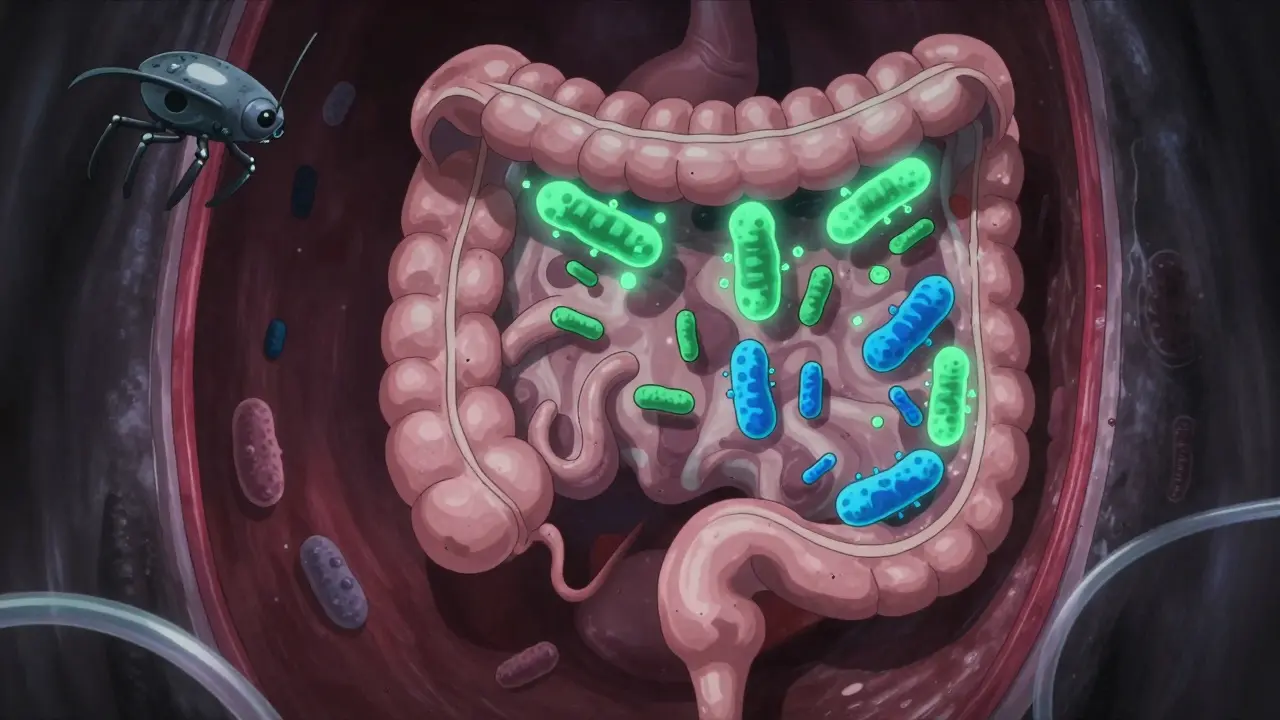
Your small intestine isn’t supposed to be full of bacteria. That’s your colon’s job. In a healthy gut, only about 10,000 to 100,000 bacteria live per milliliter of fluid in the small intestine. When that number jumps past 100,000, you’ve got SIBO. The bacteria ferment food too early, before your body can absorb nutrients. That’s what causes bloating, diarrhea, constipation, and even weight loss or malnutrition over time.
SIBO doesn’t just happen out of nowhere. It’s usually a symptom of something else. Think about it: if your gut doesn’t move food along properly-maybe because of past surgery, diabetes, or long-term use of acid-reducing drugs like omeprazole-bacteria can settle in and multiply. People with cirrhosis, gastroparesis, or even those who’ve had gastric bypass are at higher risk. And if you’ve been on proton pump inhibitors (PPIs) for years, your risk is two to three times higher.
How Do You Test for SIBO? Breath Tests
The most common way to test for SIBO is with a breath test. It’s simple: you fast for 12 hours, then drink a sugar solution. After that, you blow into a bag every 15 to 20 minutes for about two hours. The machine measures gases in your breath-mainly hydrogen and methane.
Why gases? Because when bacteria in your small intestine digest sugar, they produce these gases. If you’re producing a lot of hydrogen or methane too soon, it means bacteria are hanging out where they shouldn’t be.
There are two main types of sugar used:
- Glucose breath test: Glucose gets absorbed quickly in the first part of the small intestine. So if you show a big spike in gas early on, it’s a strong sign of SIBO. This test is more specific-meaning fewer false positives-but it can miss SIBO in the lower part of the small intestine. Sensitivity is around 46%.
- Lactulose breath test: Lactulose isn’t absorbed by the body. It travels all the way through the small intestine, so it can catch SIBO further down. But because it moves slowly, it can also give false positives if your gut moves too fast. Sensitivity is higher-about 62%-but specificity drops to 71%.
Here’s the catch: about 15-20% of people don’t produce hydrogen at all. They’re “non-hydrogen producers.” That’s why methane testing matters. Methane is linked to constipation, and high methane levels mean you might have a different type of overgrowth called intestinal methanogen overgrowth (IMO). Treating methane-dominant SIBO often needs a different combo of antibiotics.
Why Breath Tests Are Controversial
Not everyone agrees breath tests are reliable. Dr. Hisham Hussan at UC Davis Health says they’re only about 60% accurate. That means 4 out of 10 people get the wrong result. Why? Because the test doesn’t show which bacteria are there. It just shows gas. You can have a spike from rapid transit, not SIBO. Or your prep wasn’t perfect.
Preparation is everything. If you took antibiotics in the last 4 weeks, used laxatives or prokinetics in the last week, or ate high-fiber foods the day before, your test could be useless. Even drinking coffee or chewing gum before the test can mess it up. Studies show that 25-30% of inconclusive results come from patients not following prep rules.
And labs don’t all use the same cutoff. Some call a 10 ppm rise in hydrogen a positive. Others stick to 20 ppm. That’s why two different labs might give you two different results.
The Gold Standard? It’s Not What You Think
The real gold standard for diagnosing SIBO is a fluid sample taken during an endoscopy. A doctor threads a tube past your stomach, into the jejunum (the middle part of the small intestine), and collects 3-5 mL of fluid. Then they culture it in a lab to count the bacteria.
This method gives you the exact number of bacteria-and even which species they are. That’s huge. If you’re overgrown with E. coli, you might need one antibiotic. If it’s Klebsiella, you need another. Breath tests can’t tell you that.
But here’s the problem: this procedure is invasive, expensive ($1,500-$2,500), and only available in a few major hospitals. UC Davis became the first in Northern California to do it routinely in August 2024. Most clinics don’t have the equipment or the expertise.
So breath tests remain the default-not because they’re perfect, but because they’re the only practical option for most people.
Treatment: Antibiotics and Beyond
If your breath test is positive, treatment usually starts with antibiotics. The most common is rifaximin (Xifaxan), taken at 1,200 mg per day for 10 to 14 days. It works because it stays mostly in the gut-it doesn’t get absorbed into your bloodstream. Studies show 40-65% of people improve after one course.
But here’s the kicker: more than 40% of people get SIBO again within 9 months. Why? Because antibiotics don’t fix the root cause. If your gut motility is slow, or your stomach acid is low, the bacteria will come back.
For methane-dominant cases (high methane on breath test), doctors often add neomycin to rifaximin. This combo works better than rifaximin alone.
Some people try herbal antibiotics instead-like oregano oil, berberine, or garlic extract. A 2020 review found they can be just as effective as rifaximin in some cases. But they’re not regulated, and dosing varies.
After antibiotics, many people switch to a low-FODMAP diet or a specific carbohydrate diet (SCD) to starve the bacteria and prevent recurrence. But diet alone won’t cure SIBO. It just helps manage symptoms.

What’s Next for SIBO Testing?
Researchers are working on better tools. At Cedars-Sinai, Dr. Mark Pimentel’s team is testing a new breath analyzer that claims 85% accuracy. Mayo Clinic and Johns Hopkins are developing methods to sample gases directly from the intestine using tiny capsules. Others are exploring DNA sequencing of gut bacteria from stool samples to predict SIBO risk.
For now, though, breath testing is still the standard. And while it’s far from perfect, it’s the most accessible tool we have. The key is to interpret results with your doctor-not in isolation. If your symptoms match the test, even if the numbers are borderline, treatment might still help.
Bottom Line
SIBO isn’t a myth. It’s a real, measurable condition that affects millions. Breath tests aren’t flawless, but they’re the best we’ve got. If you’ve been told you have IBS and nothing’s worked, ask your doctor about SIBO testing. Make sure you follow the prep rules exactly. And if you test positive, don’t stop at antibiotics-look for what’s causing the overgrowth in the first place. Otherwise, you’ll be stuck in a cycle of treatment and return.
Can a breath test for SIBO be wrong?
Yes. Breath tests can give false positives and false negatives. False positives happen when gas rises too early due to fast gut transit, not SIBO. False negatives occur in people who don’t produce hydrogen or methane, or if the test prep wasn’t followed. Studies suggest breath tests miss or misdiagnose SIBO in up to 40% of cases.
Is SIBO the same as IBS?
No, but they overlap a lot. Up to 85% of people diagnosed with IBS may actually have SIBO. The symptoms-bloating, gas, diarrhea, constipation-are nearly identical. That’s why many doctors now test for SIBO before labeling someone with IBS.
Do I need an endoscopy to diagnose SIBO?
Not usually. Breath tests are the standard because they’re non-invasive and widely available. But if your symptoms don’t improve with treatment, or if your breath test is unclear, your doctor might recommend an endoscopy with fluid culture. It’s more accurate and can identify the exact bacteria involved.
Why do some people get SIBO again after treatment?
Because antibiotics kill bacteria but don’t fix the underlying problem. If your gut motility is slow, your stomach acid is low, or you’re still taking acid-reducing drugs, bacteria will regrow. Long-term management often requires dietary changes, prokinetics, and addressing root causes like diabetes or past surgery.
Can I test for SIBO at home?
Some companies sell at-home breath test kits. You collect breath samples and mail them to a lab. These can be useful, but they’re only as good as your prep. Many people mess up the fasting or diet rules, leading to inaccurate results. Always confirm results with a gastroenterologist.



trudale hampton
March 21, 2026 AT 03:25Really appreciate this breakdown. I’ve been dealing with bloating for years and was told it’s IBS, but nothing helped until I got tested for SIBO. Breath test came back positive for hydrogen-dominant. Rifaximin worked like magic for me - no more midday crashes after lunch. Just wish more docs knew about this.
Solomon Kindie
March 21, 2026 AT 15:37Natali Shevchenko
March 23, 2026 AT 02:13It’s fascinating how something so fundamental - the movement of food through the digestive tract - gets completely overlooked in mainstream medicine. We treat symptoms like they’re isolated events, when really SIBO is often a downstream effect of deeper dysregulation: low motility, poor vagal tone, chronic stress, even structural changes from past surgeries. The breath test is just a symptom indicator, not a root cause diagnosis. And yet, we jump straight to antibiotics like it’s a bug to be eradicated, not a sign that the ecosystem is out of balance.
Maybe what we need isn’t just better tests, but better frameworks for understanding gut health as a whole system - not a series of isolated problems to be patched.
Johny Prayogi
March 24, 2026 AT 03:46YES. I did the lactulose test and got a borderline result. My doc was like 'eh, maybe' - but I went full low-FODMAP + prokinetic (prucalopride) and my bloating dropped 80%. If your symptoms match, don’t wait for a perfect test. Also, if you're on PPIs, stop. Like, actually stop. Ask your doctor about tapering. I was on omeprazole for 7 years and didn’t realize it was part of the problem.
Also 🙌 to herbal options. Berberine + oregano oil combo saved my life after the first round of Rifaximin failed. Not regulated? Yeah. But better than nothing when Big Pharma won’t help.
Thomas Jensen
March 24, 2026 AT 21:06Wait… so you're telling me the whole medical system is just running on guesswork? And they're using breath tests like it's a Ouija board? I'm starting to think this is all a Big Pharma scam to sell antibiotics and expensive supplements. Why don't they just do the endoscopy on everyone? It's 2024. We have drones, AI, and self-driving cars - but we still can't test a gut properly? Something's fishy.
Also, why is Cedars-Sinai the ONLY place doing this? Coincidence? Or are they hiding something? 🤔
matthew runcie
March 25, 2026 AT 00:00Good post. I’ve had two breath tests - one positive, one negative. Same prep, different labs. Ended up going with symptoms over numbers. Took rifaximin, stayed on low-FODMAP, and now I’m stable. No magic cure, but better than before. Just don’t let the test define you.
shannon kozee
March 25, 2026 AT 10:46Don’t skip the prep. I ate avocado the day before. Test was useless. Lesson learned.
Shaun Wakashige
March 27, 2026 AT 03:54Paul Cuccurullo
March 28, 2026 AT 01:46It is profoundly disheartening to witness the chasm between medical science and clinical practice. While we possess the technological capacity to decode the human genome, we persist in relying on crude, imperfect tools to diagnose a condition that alters lives. The fact that an invasive, costly, and highly accurate procedure - endoscopic fluid culture - remains a rarity speaks volumes about systemic neglect. One cannot help but wonder: Is this a failure of resources, or a failure of will?
Let us not mistake accessibility for adequacy.
Nicole James
March 28, 2026 AT 07:01Have you considered that the breath test isn’t broken… it’s being manipulated? I read a whistleblower report last year - labs are being pressured to ‘normalize’ results because insurance won’t cover treatment unless it’s ‘confirmed.’ And the glucose vs. lactulose debate? That’s not science - that’s corporate lobbying. Glucose tests are cheaper. Lactulose catches more cases. Guess which one the big pharma labs push? And don’t even get me started on the methane cutoffs… they changed them after the 2022 study. Why? Because too many people were getting diagnosed. It’s not incompetence. It’s intentional.
Also - who funds the ‘herbal remedy’ studies? Hint: It’s not the NIH.